

The Atlas Brief - Vol VII · July 2026

Editor's Note - July 2026
Somewhere around June 12, a man on the other side of the world became the richest human being who has ever lived. It happened on a Friday. The market opened, some numbers moved, and by lunchtime, the wealthiest person in the history of the species had a name and a stock ticker.
Nobody I know felt richer that day. I'd guess nobody you know did either.
That gap, between an event genuinely large enough to make history, and an event that changed nothing at all for almost everyone reading this. is what this edition turned out to be about, though it didn't start that way. We picked "Wealth, Power, and Who Gets to Flourish" as a theme before the SpaceX IPO priced, back when it was still a headline we assumed we'd cover briefly. Then the number came in, and it kept climbing, and it became obvious this wasn't a story about one company. It was a mechanism, and once you see it in one place, you start noticing it everywhere else too: in nine centuries of who got invited into a library, in a tax code that treats a fortune as invisible until someone chooses to cash it in, in a community garden in Adelaide that does more measurable good for its members' wellbeing than most policy papers manage.
This edition tries to hold both of those things at once, the scale of what's being taken and the scale of what's already being built as an alternative, without anyone needing to become a trillionaire first. Read the Deep Dive for the mechanism. Read Systems & Signals for the proof it isn't inevitable. Read Solaria's piece for what the alternative actually looks like when someone measures it properly.

The Brief
The month's headlines, with the context they deserve.
30 Days... Same Racket
A rundown of who flourished this month, and who was told to be patient.
Nothing "happened" this month, exactly. Nothing ever does. It's more that the same machine kept running with the lights on, and every so often it coughed up a number so absurd someone had to write it down. Here are five of them, and one reminder, that none of them is actually the biggest story.
The CEO-to-worker pay gap did what it always does: got worse, then got a press release about "commitment to talent retention.
The median S&P 500 CEO now earns 99 times their typical employee. The average earns 216 times. Sit with the gap between "median" and "average" for a second, it means a handful of pay packages are so cartoonish they drag the whole curve upward with them, like one guest at a otherwise normal dinner party who insists on arriving by helicopter. Tesla supplied this month's cartoon: a pay ratio of 2,522,203 to 1, against a median worker salary of $62,786. Somewhere in that company's boardroom, someone looked at that number and decided the real risk to shareholders was complacency.
Meanwhile, actual human wages continue their long tradition of almost keeping up.
Australian inflation sat at 4.2–4.6% through the first half of the year. Wage growth for the lowest-paid workers came in at 3.4%. That's not a rounding error, that's a pay cut wearing a name badge that says "Growth." Mortgage holders, regional communities, and low-income households were named as most exposed which, translated out of the polite economist dialect, means: the people with the least padding are the ones taking the hit, again, same as every other month this has ever been written about.
The billionaire class, for its part, is doing just fine, thanks for asking.
There are now 3,302 billionaires worldwide, a record, up 13.1% in a year. Combined billionaire wealth grew 25% over the same period.[3] Larry Ellison alone added $71 billion in a single month, the largest one-month gain ever recorded for one person, because enterprise software companies discovered they could put "AI" in the deck and the market would simply believe them, the way a toddler believes a blanket makes them invisible.
Closer to home, Gina Rinehart's Hancock Prospecting landed a $1.4 billion allocation in the SpaceX IPO
The same record-breaking, wildly oversubscribed offering covered in this edition's Deep Dive, the one where ordinary retail investors mostly received a single share each and a stern note about lock-up periods. Hancock's chief executive described the allocation as reflecting "international regard" for Rinehart. Retail investors received cannon-fodder status and a screenshot-worthy consolation prize. Truly, the market rewards different kinds of relationship-building, and it is not subtle about which kind it prefers.
And in the one piece of actual, structural news this month: the negative gearing and capital gains tax reforms covered in Vol VI's housing Deep Dive passed the Senate on 25 June.
Real change, new investors can no longer fully offset losses on existing homes against their wages, and the CGT discount is being replaced with something that resembles arithmetic. It took forty years, a housing crisis, and a government finally deciding that losing an election was scarier than losing a donor. Progress, it turns out, mostly happens the way everything else happens: slowly, and then because someone ran out of better options.
None of the above will matter much if the Pacific Ocean's current mood swing goes the way it's currently heading.
Sea surface temperatures jumped from 0.7°C above average in early June to 1.1°C above average by mid-June. Eleven of thirteen major forecast models now put this El Niño at "Super" category by spring, and eight of those thirteen predict it will exceed the previous historical maximum, set in 1982–83. Translation: forecasters who spend their careers being professionally cautious are, with unusual unanimity, using the word "unprecedented" about the weather while the rest of us argue about share allocations. Keep an eye on this one. It will still be here after the quarterly earnings calls are forgotten.
Same month, next door. Try to enjoy it.

Deep Dive
Long-form explorations of the ideas shaping our future.
The IPO That Rewrote The Rules
How to Pull the Heist of the Millennium and Not Even Wear a Mask
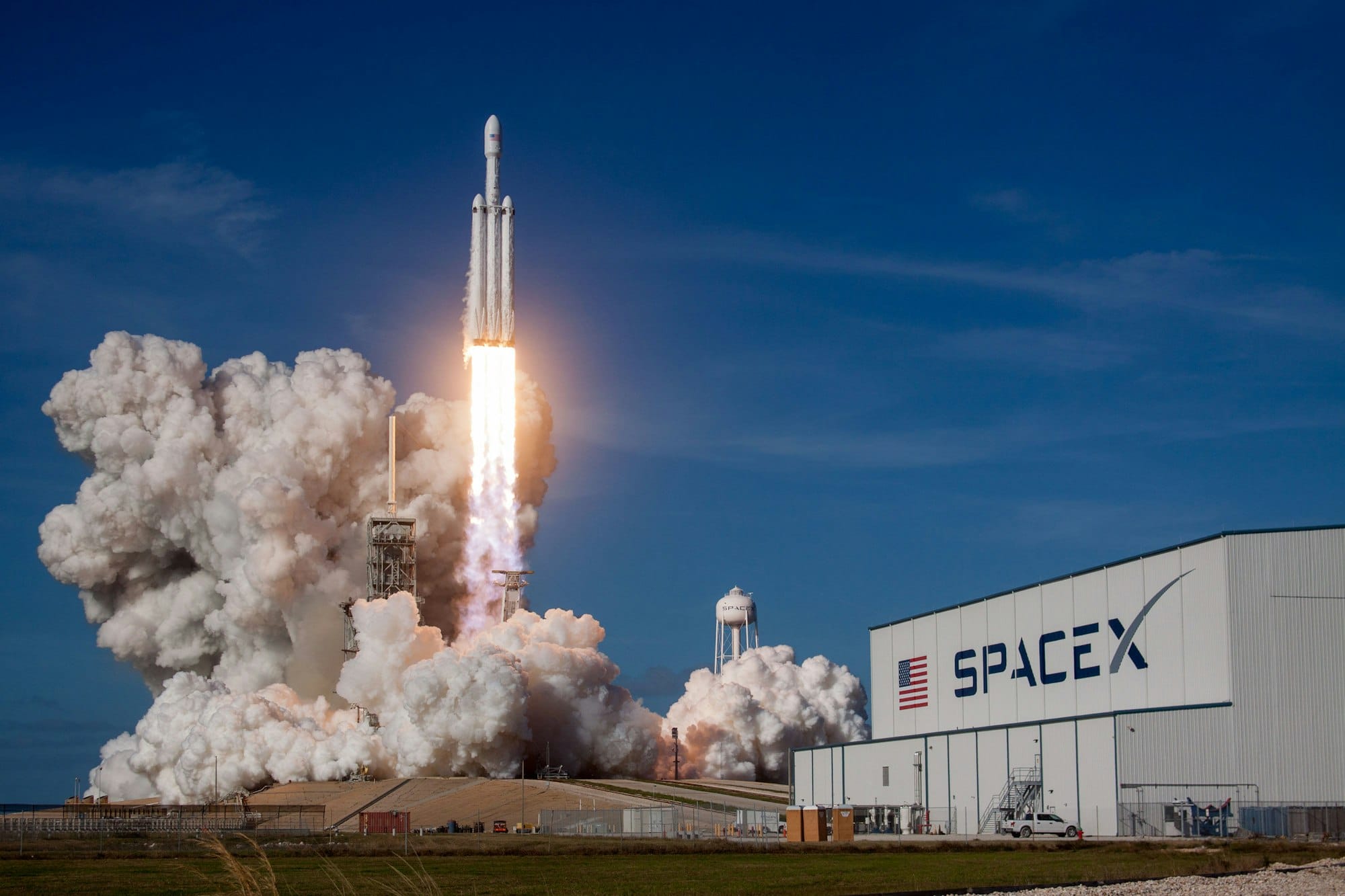
The SpaceX IPO as a case study in modern wealth extraction
On the morning of June 12, 2026, a man became the wealthiest human being who has ever lived, by a margin so large that "wealthiest" undersold it. Elon Musk's stake in SpaceX, on paper, made him the first trillionaire in history. Nobody wore a mask. Nobody needed to. Everything about it was filed with regulators, priced by underwriters, and reported live on CNBC.
That is, in a sense, the whole story. The biggest heists don't happen in vaults anymore. They happen in prospectuses.
This isn't a piece about whether Elon Musk is a good or bad person, or whether rockets are cool (they are). It's about a mechanism: how a company can turn public money, public risk, and public infrastructure into an almost entirely private fortune, in full view, with the paperwork to prove it, and walk away with the crowd cheering.
Think of it as a heist movie. Every heist needs a vault, a getaway vehicle, and someone left holding the bag. SpaceX's IPO had all three.
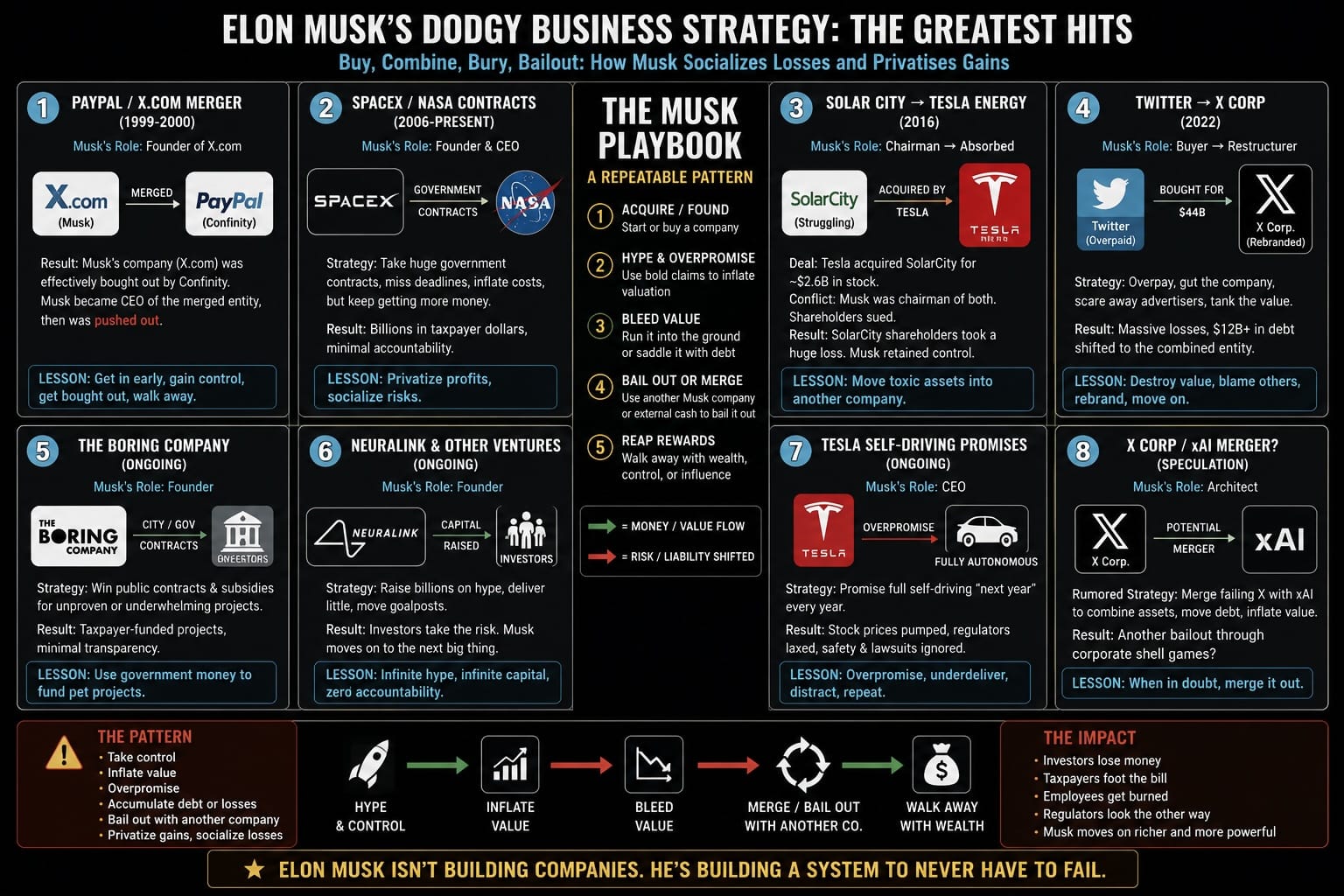
The Vault: Who Actually Filled It
Before SpaceX was worth $1.77 trillion, it needed a business. A very large part of that business is the United States government.
SpaceX has $22 billion in cumulative federal contracts across NASA, the Space Force, the National Reconnaissance Office, and the Space Development Agency, a figure that comes directly from SpaceX president Gwynne Shotwell, not a critic. In 2024 alone, the company booked $3.3 billion in unclassified government revenue and holds 52 active federal contracts worth a combined $11.8 billion in remaining value, and that's before counting whatever sits behind a classification stamp. In the weeks before the IPO, the Space Force topped up the till with a $6.45 billion round of national security launch awards, on top of an earlier National Security Space Launch contract worth up to $5.9 billion running through 2029.
SpaceX now launches most of America's classified intelligence satellites, builds the lunar lander for NASA's Artemis program, and operates Starshield, the military's primary low-Earth-orbit satellite network. This is not a company selling a product to the government on the open market and hoping for the best. It is, in large part, a government contractor whose single largest and most reliable customer is the government itself, a customer that cannot easily walk away, because the alternative is that America stops reliably getting things into orbit.
$11.4 billion in 2025
Generated by Starlink, about 61% of SpaceX's total revenue, up roughly 50% from $7.6 billion the year before.
"SpaceX stock has soared above its IPO price. Here's why" — ABC News, June 2026
Guaranteed government demand is not, by itself, scandalous. Boeing, Lockheed, and half of Silicon Valley run on the same fuel. What makes SpaceX's version notable is what happens next: that guaranteed, taxpayer-underwritten revenue becomes the floor under a private valuation that the company's own IPO buyers, in less than four months, would already be arguing about by hundreds of billions of dollars.
The Getaway Vehicle: A Company You Can Own But Never Run
Here is the part of the heist where you make sure that, whatever happens to the money afterwards, nobody can catch you or make you give it back.
SpaceX went public with a dual-class share structure. Public investors bought Class A shares, one vote each. Musk and other insiders hold Class B shares, worth ten votes apiece. Senator Elizabeth Warren, in a formal letter urging the SEC to delay the IPO, calculated that this structure gives Musk roughly 82.4% of total voting power and 93.6% of the Class B shares specifically required to remove him as chairman or chief executive.
Elizabeth Warren, Letter to SEC Chair Paul Atkins — June 2026]
"SpaceX's structure gives Musk an "unprecedented level of power" over investors, who would have "significantly fewer rights than those traditionally offered to purchasers of public shares."[6]"
It doesn't stop at voting shares. Warren's letter also flagged mandatory arbitration clauses, stricter-than-usual limits on shareholder proposals, and incorporation under Texas law, a jurisdiction friendlier to controlling shareholders than Delaware, where most large American public companies incorporate specifically because Delaware courts have a century of case law protecting minority shareholders. Stack all of it together, and you get a company that trades on a public exchange, uses public capital, and is structurally almost impossible for the public who bought shares in it to ever hold accountable.
You are, in the fullest legal sense, an owner. You are, in every practical sense, a spectator.
The Marks: Who Was Left Holding the Bag
Every heist needs someone who doesn't get let in on the plan. In this one, it was the people who actually wanted to buy the stock.
SpaceX reserved up to 30% of its roughly $75 billion offering for retail investors, a genuinely unusual, almost generous-looking allocation for an IPO this size.[7] It didn't matter. Demand ran 3.5 to 4 times the available supply, orders had to survive broker queues and funded-demand checks, and by the time shares actually landed in accounts, plenty of retail investors who'd requested hundreds or thousands of shares got one. On Reddit, the screenshots of single-share allocations became their own genre of joke: a $135 souvenir of the biggest IPO in history.
The asymmetry didn't end at allocation. Platforms including Fidelity, Robinhood, E-Trade, and SoFi imposed 15-to-30-day restrictions preventing small investors from selling their shares immediately. Large institutional buyers faced no such lock-up. One asset manager who received a roughly $300 million allocation told Reuters, without apparent embarrassment, that they intended to sell straight into the open market and have their cash back within five days. As one analyst put it to Reuters, retail investors were being used "as cannon fodder", a "cushion to absorb some of the risk from how highly priced the stock is."
The Pattern
Guaranteed government revenue underwrites the valuation. A dual-class structure insulates the founder from any consequence of that valuation being wrong. And the investors most exposed to that risk, the ones locked in for a month while institutions cash out in five days, are the ones with the least information and the smallest checks.
The Paper Trail Doesn't Quite Add Up
Warren's letter raised one more thing worth sitting with: the accounting behind the number itself. Part of her concern was "inaccurate or misleading accounting or valuation" tied to SpaceX's acquisition of xAI, Musk's own artificial intelligence company, which closed in February 2026 and was folded into SpaceX's business just months before the IPO. Buying a related company you already control, at a price you helped set, shortly before taking the combined entity public, is not illegal. It is, however, exactly the kind of transaction that makes "what is this actually worth?" a harder question to answer honestly.
It is a question Wall Street itself can't agree on. Morningstar valued SpaceX at less than half its $1.75 trillion IPO target. CFRA opened coverage with a sell rating and a 12-month price target of $115, well below the $135 IPO price. NewStreet Research, by contrast, initiated at $165, arguing the valuation only makes sense across a 20-to-25-year horizon. When professional analysts disagree by a factor of nearly two on what a company is worth, "worth" has become at least partly a matter of narrative, and narrative, unlike a balance sheet, is something a controlling shareholder with ten votes per share has considerable power to shape.
What's Actually Real Here
None of this works as an honest piece of journalism if it pretends SpaceX is only a valuation trick. It isn't. This is the point where the heist metaphor has to yield to the facts, because some of what SpaceX built is genuinely, measurably real.
Reusable rockets are not marketing. A Falcon 9 launch runs somewhere in the $67–74 million range, against roughly $110–160 million for a comparable expendable Atlas V, and launch costs per kilogram to orbit have fallen from over $10,000 in the Shuttle era to somewhere around $2,600–2,700 under a reused Falcon 9. Starship is designed to push that further, though its real-world cost-per-kilogram at scale hasn't been demonstrated yet and shouldn't be quoted as a settled fact. What has been demonstrated: satellite operators increasingly prefer flying on reusable vehicles because the economics are, measurably, better. That is a genuine engineering and industrial achievement, one that has made satellite constellations, space science, and yes, Starlink's rural connectivity cheaper and more viable than they were a decade ago. Crediting the mechanism of extraction should not require pretending the underlying technology is fake. Both things are true at once: SpaceX built something real, and the structure around who gets to own the value of it was engineered just as deliberately.
The Tax Angle, Because There's Always a Tax Angle
Here is the part of the mechanism that has nothing to do with SpaceX specifically, and everything to do with why this kind of wealth is so durable once created.
ProPublica's 2021 analysis of leaked IRS data found that between 2014 and 2018, Musk's wealth grew by $13.9 billion, and he paid $455 million in federal income tax over the same period, a "true tax rate," measured against wealth growth rather than reported income, of 3.27%. In 2018, he paid no federal income tax at all. The reason isn't a loophole in the criminal sense. It's structural: the value of a $1.14 trillion stake in SpaceX is not "income" under U.S. tax law until shares are sold. Wealth can compound, on paper, indefinitely, without ever passing through the tax system that funds the government contracts underwriting it in the first place.
That is the closed loop worth naming plainly. Public money purchases guaranteed revenue. Guaranteed revenue inflates a private valuation. The valuation becomes paper wealth. Paper wealth is not meaningfully taxed unless and until its owner chooses to sell. The public pays in at the start of the cycle and, structurally, is not positioned to collect anything resembling a proportional share at the end of it.
Why It Matters
None of this required Elon Musk to be uniquely villainous. That's the uncomfortable part. Every piece of this mechanism, the dual-class shares, the government contract dependency, the retail lock-up, the unrealised-gains tax treatment, is legal, common, and available to any founder with enough leverage to demand it. SpaceX is simply the largest version yet of a pattern American markets have quietly normalised for decades: privatise the upside, socialise the exposure, and structure the paperwork so the person at the centre of it can never be outvoted and rarely has to pay tax on the part that matters most.
The Systems & Signals piece in this edition asks when societies have managed to build the opposite of this, periods when the gains from public knowledge and public infrastructure flowed more broadly rather than pooling at the top. It's worth reading them side by side. This one is the mechanism. That one is the counter-evidence that a different mechanism has existed before and worked.
Elon Musk didn't need a mask on June 12. The paperwork was the mask. It just happened to be filed in public, in plain English, with everyone's name on it, and almost nobody read it closely enough to notice what it said.
Notes & Sources
The following sources informed or support this article. Primary sources are preferred where available.

Systems & Signals
Connecting ideas across history, science and society.
When Did We Flourish and Why?
The Islamic Golden Age, the Renaissance, and the Enlightenment as counter-evidence to trickle-down economics
The pitch has been the same for forty years, in every country that's tried it: let wealth concentrate at the top, and it will find its way down to everyone else eventually. Cut the taxes on capital, the argument goes, and the capital will build the factories, hire the workers, and fund the innovations. Prosperity trickles down. It has a physics-like confidence to it, like water finding its level.
Water does find its level. Wealth, it turns out, does not, at least not on its own. Three of history's most celebrated flourishings offer a cleaner test of the theory than any modern election ever could, because in each case, the money was already at the top before anything interesting happened. What made the difference wasn't the concentration. It was what the people holding the money chose to build with it, and specifically, whether they built something that let more people in, or something that kept them out.
Baghdad, 813 AD: The Academy With an Open Door

The Abbasid Caliphate was, by any measure, an absolute monarchy sitting on immense concentrated wealth. Nobody voted for the caliph. There was no parliament redistributing tax revenue. If trickle-down worked the way its modern advocates describe, this is exactly the setup that should have produced nothing but palaces.
Instead, it produced the House of Wisdom. Caliph al-Ma'mun, who ruled from 813 to 833, inherited an institution that had begun decades earlier as a court library and translation office, and turned it into something categorically different: a public academy. Every citizen of the empire, and travellers arriving from as far as Europe, were welcome to study there. Al-Ma'mun didn't just fund it from a distance; he visited regularly, personally checked in on the scholars' work, and treated intellectual output as something worth his direct attention, not just his money.
The wealth was concentrated. The access to what that wealth produced was not. Translators rendered Greek, Persian, and Indian texts into Arabic on a massive scale; mathematicians developed algebra; astronomers built on Ptolemy rather than simply preserving him. None of this required the caliph to give up his fortune. It required him to spend a fraction of it on something structurally open rather than something structurally exclusive, a public academy instead of a private vanity collection.
What ended it is worth reading as closely as what built it. From the eleventh century, more conservative theological currents gained ground, with scholars like al-Ghazali arguing that reason should be subordinate to revelation — narrowing the intellectual space that had allowed open inquiry to flourish. The Abbasid Caliphate then fragmented into competing dynasties, and patronage for scholarship declined along with it. By the time the Mongols sacked Baghdad in 1258 and destroyed the House of Wisdom's physical collections, historians generally agree that the institutional heart of the golden age had already been weakening for well over a century; the fall of Baghdad was the final blow to something that had already been starved of the openness and stability it needed. The lesson isn't "invasions end golden ages." It's that golden ages built on open access are fragile the moment the access starts closing, well before anyone sacks the library.
Florence, 1400s: The Wealth That Had to Answer to Someone

The popular version of the Renaissance is a story about the Medici, one very rich family bankrolling Michelangelo, and civilisation trickling down from their patronage. It's not wrong, but it's incomplete in a way that matters.
Florence's wealth wasn't concentrated in one dynasty before the Medici rose; it was distributed across a genuinely broad merchant class, organised into guilds, the Arte della Lana for wool, the Arte di Calimala for finished cloth, that governed nearly every aspect of civic and economic life. These guilds weren't charities. They were self-interested economic organisations. But their structure meant that political authority and mercantile wealth were tied together through networks that a comparatively wide slice of the city's population could enter, rise within, and use to reach positions of civic influence. Social mobility was, by the standards of the period, unusually attainable. Wealth answered to a civic ethic, however imperfectly enforced, that linked commercial success to public responsibility.
The Medici built their patronage on top of that foundation, not instead of it. When Cosimo and later Lorenzo de' Medici funded painters, sculptors, and architects, they were spending concentrated wealth into a city whose economic and political life was already unusually participatory for the era. Take away the guild structure and the civic-mercantile culture underneath it, and Medici money alone doesn't produce a Renaissance; it produces a very well-decorated palace.
London and Paris, 1700s: A Penny Bought You Into the Conversation
By the time you reach the Enlightenment, the mechanism becomes almost embarrassingly literal. For the price of a cup of coffee, a person in London or Paris could walk into a coffeehouse, read the day's newspapers and pamphlets, and join whatever argument the room was having about philosophy, politics, or the latest scientific paper. Historians studying the period, building on Jürgen Habermas's work on the public sphere, describe English and German coffeehouses in particular as the most consequential informal institutions of the age, places where literate private citizens exchanged ideas about public affairs in a way that increasingly challenged inherited authority, all for the cost of admission a labourer could usually afford.
This didn't happen in a vacuum. European literacy rose from roughly 20% in 1600 to over 50% by 1800, considerably higher again in cities like London and Paris. The number of new book and pamphlet titles published each year climbed from around 1,000 in the early 1600s to more than 10,000 by the late 1700s, a tenfold expansion in the raw supply of ideas available to anyone who could read and afford a penny. None of that required aristocratic wealth to personally redistribute itself. It required the falling cost of printing and the rising rate of literacy to open a door that had previously been closed to almost everyone outside a tiny educated elite.
What the Data Says When You Test It Properly
None of the above proves anything on its own; three cherry-picked centuries are exactly the kind of "reasonable inference" this publication tries not to oversell as proof. So it's worth turning to the modern econometric literature that has actually tried to test the trickle-down claim at scale, because the results land in the same place.
"The International Monetary Fund examined 159 advanced and developing economies between 1980 and 2012 and found that when the income share of the richest 20% increases by one percentage point, GDP growth over the following five years actually falls by 0.08%. When the income share of the poorest 20% increases by the same amount, GDP growth rises by 0.38% over the same window."
The paper's five authors were blunt about the implication: concentrating income at the top doesn't just fail to trickle down; it measurably drags growth down with it.
A separate 2020 study by economists David Hope and Julian Limberg, examining fifty years of data across eighteen countries, looked specifically at tax cuts for the wealthy, the primary policy lever trickle-down theory actually recommends. They found such cuts reliably increased inequality and had no significant effect on GDP per capita or employment in either the short or medium term. The tax cuts did exactly one thing reliably: made the people receiving them richer. Everything downstream that was supposed to follow didn't.
The Honest Caveats
It would be dishonest to present the House of Wisdom, Medici Florence, or Enlightenment London as some kind of proto-egalitarian utopia, and this publication isn't in the business of manufacturing a cleaner past than the one that existed. Baghdad's public academy still operated inside an absolute monarchy that enslaved people and excluded women from formal scholarship almost entirely. Florence's guilds were closed shops that most of the city's population, labourers, the poor, and most women, never got near. English coffeehouses were, for most of the period, spaces reserved for men. None of these societies distributed opportunity anything like evenly, and none of them should be held up as a template to copy wholesale.
What's defensible, rather than romantic, is narrower and more useful: in each case, when the people holding concentrated wealth spent some of it building structures that let more people than usual participate, a public academy instead of a private library, a civic-guild economy instead of pure aristocratic inheritance, a penny-priced public sphere instead of salons for the already-connected, the resulting flourishing outlasted and outgrew anything the same wealth would have produced sitting in a vault, waiting to trickle down. And when that access narrowed again, through theological retrenchment, political fragmentation, or simple neglect, the flourishing narrowed with it, well before any invading army arrived to take the blame.
Why It Matters
The Deep Dive in this edition is the mechanism: wealth extracted upward, structurally insulated from consequence, barely taxed on the way. This piece is the counter-evidence, proof that a different mechanism has existed, repeatedly, in wildly different centuries and civilisations, and that it produced results the extraction model has never matched. Not through redistribution in the modern tax-and-transfer sense, necessarily, but through the more basic choice to build things, academies, guild economies, penny-priced public spheres, that let people in rather than keeping them out.
The pitch that wealth trickles down has had forty years and 159 countries' worth of data to prove itself. It hasn't. The alternative isn't a theory. It already happened, more than once, and we know roughly what it looked like when it did.

Culture & Media
Exploring the stories that shape how we see the world.
Two Ways to Tell the Same Story
The Wolf of Wall Street and The Big Short told it as fact. Parasite and Succession didn't need to.
There are two ways to put wealth and power are often represented on screen. One is to find the true story and dramatise it, name attached, real consequences implied. The other is to invent something so structurally accurate that nobody needs to check whether it really happened, because the mechanism is the point, not the biography. This edition's theme has produced landmark examples of both.
The Wolf of Wall Street (2013)
Martin Scorsese's adaptation of Jordan Belfort's memoir is, by design, an unreliable narrator's version of his own crimes, glossy, propulsive, and told entirely from inside the con. That's also its most persistent criticism. Danny Porush, the real person behind Jonah Hill's Donnie Azoff, has disputed large stretches of the film as invention, and multiple critics have pointed out that the movie spends nearly three hours inside Belfort's hedonism while the actual victims of his fraud barely appear on screen at all. The New York Times has reported that small business owners defrauded by Belfort's operation were still trying to recover financially years after the film's release, a detail the film itself has no room for.

Scorsese's defenders argue that's the entire point, that the film is designed to seduce the audience the same way Belfort seduced his investors, and that discomfort with how much fun it is to watch is the intended reaction, not an oversight. Both things can be true at once: it's a formally dazzling film about greed, and it's also a film that had to be told from the perpetrator's memoir because the victims' version was never going to get a $100 million budget.
The Big Short (2015)
Where Wolf of Wall Street glamorises, The Big Short indicts, and does it with a rigour that's unusual for a film this entertaining. A financial expert consulted on its accuracy gave it an 8 out of 10, and the film's most fastidious detail is almost absurd: Christian Bale spent roughly twelve hours with the real Dr. Michael Burry, the hedge fund manager who predicted the 2008 crash, and then asked to keep Burry's actual cargo shorts and t-shirt to wear on camera. The other real people behind the film's characters, Steve Eisman, Greg Lippmann, Ben Hockett, had their names changed but not their substance; the film adjusted only the details a family specifically asked to be softened, changing a plot point about the death of Eisman's infant son into a fictional sibling's suicide, at the family's request.
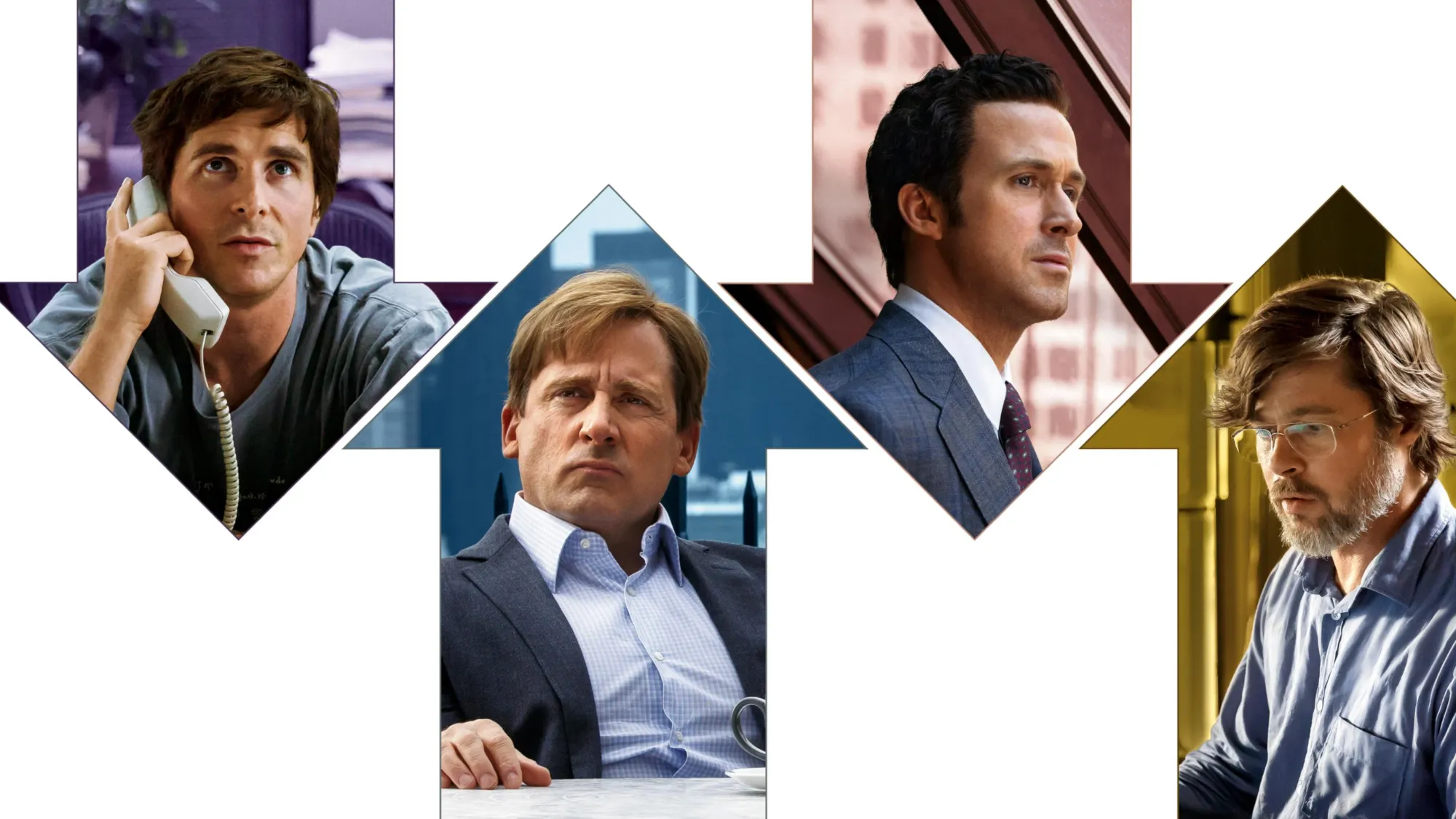
The film's real achievement isn't the finance-lecture cutaways, memorable as they are. It's the anger underneath the comedy: these were people who saw the mechanism early, tried to warn the system, and were mostly ignored or mocked for it, right up until the mechanism did exactly what they said it would.
Parasite (2019)
Bong Joon-ho's Parasite didn't need a true story, because it built a truer one out of architecture. The Park family's sleek, sun-lit, multi-level house and the Kim family's half-submerged basement apartment aren't just production design; Bong has described the film's verticality as the whole argument, the literal climb of social mobility made into a floor plan. Critics and Bong himself have called it a portrait of late-stage capitalism precisely because it refuses to locate the problem in any one villain; the wealthy Park family aren't cruel so much as oblivious, which is arguably the more devastating accusation.

The film's honours speak to how widely the mechanism translated: it won the Palme d'Or at Cannes, the first Korean film to do so, and then became the first non-English-language film in history to win the Academy Award for Best Picture, alongside directing and original screenplay. A story specific enough to be about one family's basement in Seoul turned out to be legible to essentially everyone, everywhere, which is usually a sign a film has found something true rather than merely local.
Succession (2018-2023)
Jesse Armstrong originally set out to write a film about the Murdoch family specifically. It never got made. What he built instead, across four seasons of television, was a composite, Logan Roy assembled from what Armstrong called a "holy trinity" of real media patriarchs: Rupert Murdoch, Sumner Redstone, and Robert Maxwell. The spark, by Armstrong's own account, was hearing two actual media moguls joke, when asked about succession planning, that they simply "didn't plan to die."
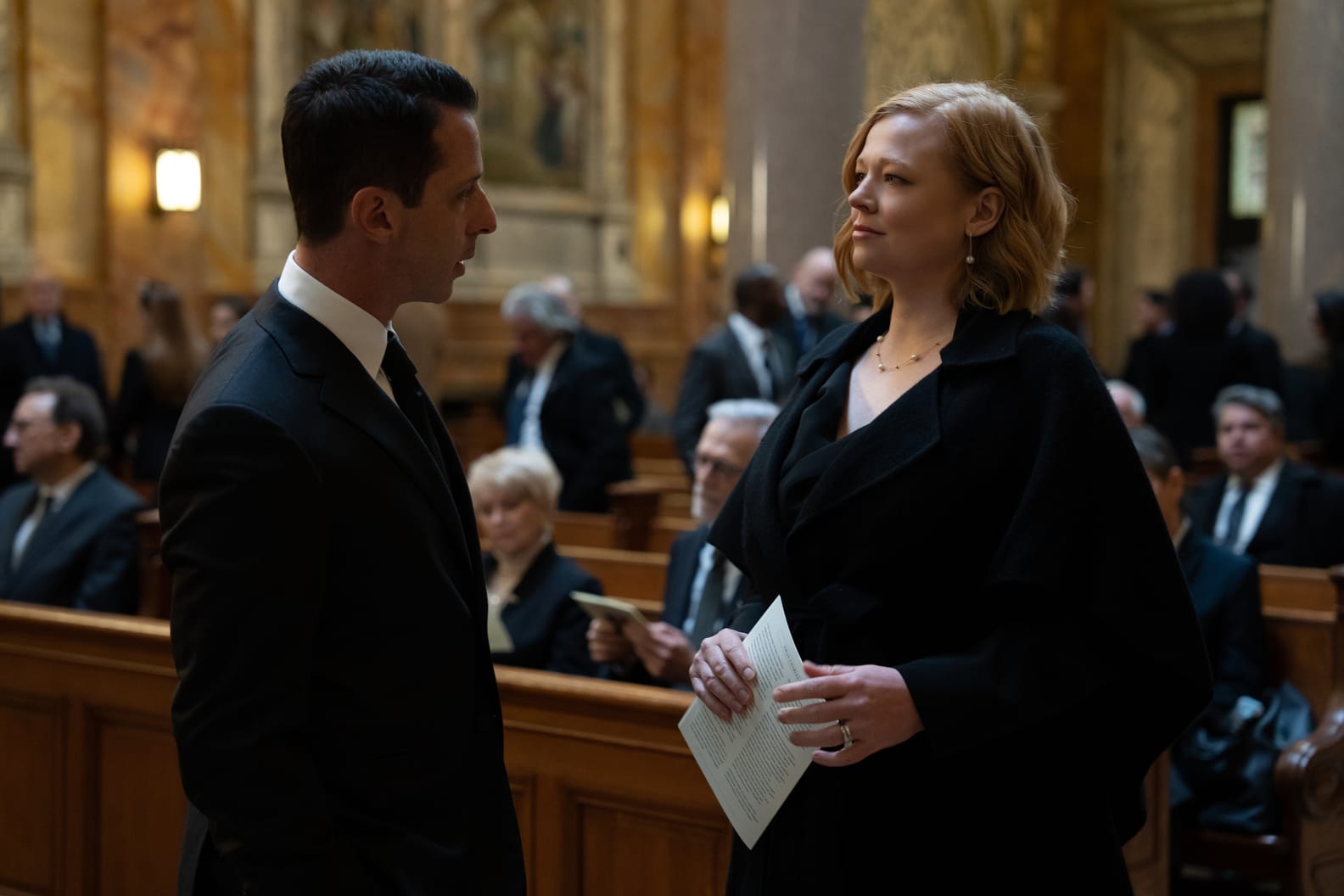
That's the whole show in one line. Succession isn't really about who inherits the empire. It's about what happens to the people standing near enormous, ageing, unaccountable power while its owner refuses to acknowledge that power is finite, the flattery, the paranoia, the children optimised from birth for a competition their father never intends to actually end. By declining to be a Murdoch biopic and choosing instead to be built from three dynasties layered into one, Armstrong made something that couldn't be dismissed as being about any single family's specific grievances. It became, instead, a portrait of the shape dynastic power takes in general, which is exactly why it landed as hard as it did.
Why Pair Them?
Wolf of Wall Street and The Big Short are what happen when the wealth-extraction mechanism gets specific enough to have a defendant. Parasite and Succession are what happen when the same mechanism gets abstracted just enough to implicate everyone who's ever stood near power without noticing what it costs the people below it. Both approaches are doing the same work this edition is doing across its other pieces: naming a mechanism precisely enough to be useful, and universally enough to be recognised.
Further Viewing:
Margin Call (2011) and Bong Joon-ho's Snowpiercer (2013), which runs the same vertical metaphor sideways down a train.

From the Librarium
Why Progress Doesn't Fix Poverty
The Book That Outsold All but the Bible
In 1879, a self-taught economist and former ship's cabin boy named Henry George published a book asking a question that should sound familiar by now: why does poverty persist, and even deepen, in exactly the places where wealth and technology are advancing fastest?
The Question Nobody Wanted Asked
George had watched California grow rich on the back of railroads and land speculation, and he watched ordinary people get poorer in the same boom. The puzzle troubled him enough to spend years working it through, and the answer he arrived at was not "greed" or "bad luck." It was structural: land. Not labour, not capital in the abstract, but the ownership of land and the value that accrues to it, value created almost entirely by the surrounding community's growth, population, and infrastructure, not by anything the landowner personally did. A railway arrives, a city grows around a plot of dirt, and the person who happened to own that dirt captures the gain, regardless of whether they built anything on it at all.
George's proposed remedy was blunt: a single tax on the unimproved value of land, replacing most other forms of taxation. Tax the value of the land itself, not what's built on it, and you remove the incentive to sit on it and speculate while everyone else's labour and investment inflates its price around you.
An Almost Unbelievable Reception
It is difficult to overstate how large a cultural moment Progress and Poverty became. In the 1890s, it was outsold only by the Bible. It sold several million copies, making it one of the best-selling books of the entire nineteenth century, written by a man with no university education and no institutional backing, publishing an argument that directly challenged the interests of every landowner reading it. It helped ignite the Progressive Era in the United States and sparked a global reform movement, "Georgism," that outlived George himself by more than a century. Tolstoy, Einstein, and Winston Churchill all counted themselves influenced by it, an unusually broad coalition for a single economics book to command.
Why It Still Matters
This edition's Deep Dive traces a mechanism by which guaranteed government contracts and structural share arrangements let concentrated wealth compound almost entirely untaxed. Vol VI's housing Deep Dive noted that land now makes up 75% of the value of Australia's housing stock, up from 54% in 1990, and that Australia's own Henry Tax Review recommended a land value tax back in 2010, a recommendation every government since has quietly declined to touch. George's argument, close to a century and a half old, is not a historical curiosity sitting next to that fact. It is the direct intellectual ancestor of the policy debate this publication has already covered, and the reason the idea kept surviving political neglect long enough to be recommended again in 2010: it was never refuted. It was simply inconvenient to the people positioned to lose from it.
None of this means George had every answer or that a single tax on land would resolve everything this edition has covered. Land value capture doesn't touch dual-class share structures or unrealised capital gains, and George wrote before anything like a modern multinational or a sovereign wealth fund existed. But the core diagnosis, that a society can generate enormous new wealth while the gains flow disproportionately to whoever already owned the ground underneath the growth, is exactly the pattern this edition keeps finding in very different centuries and very different industries.
Progress and Poverty is now available in the Atlas Librarium, free, in your browser, no account required. Read the book that outsold nearly everything in its century, and ask yourself why the question it asked still hasn't been answered.

Projects & Progress
Building Atlas media, one deliberate step at a time.
A quiet one, but a real one.
No huge news this week, just the slow, unglamorous work of building something properly. Academe keeps growing, one module at a time. WeRise's research keeps deepening in the background. Solaria's vision is still finding its final shape, which is exactly as it should be at this stage.
Muse, our personal project, is quietly becoming something we're genuinely proud of. More on that when it's ready to be shown properly, not before.
Mostly, we're learning. New skills, new tools, the unglamorous stuff nobody posts about. And we're quietly hopeful the first videos aren't far off now. 🤷♂️
More soon.