
The Atlas Brief - Vol III · March 2026

Welcome to the Atlas Brief for March 2026.
There is an old curse, disguised as a blessing: may you live in interesting times.
We are, without question, living in them.
The world in early 2026 feels like a hinge point, the kind of moment that historians will look back on and say that is when things began to shift. Whether they shift toward something better or something worse depends, as it always has, on what ordinary people choose to pay attention to, what they choose to demand, and what they refuse to accept.
Atlas Media exists precisely for moments like this one. Not to shout over the noise; there is already more than enough of that, but to think carefully, source honestly, and make space for ideas that deserve more than a headline.
This edition has been, by any measure, a substantial one. Trains and hemp, Homer and justice, a plant that cleans nuclear waste, and a story that refuses to die after three thousand years. If there is a thread connecting all of it, it is this: the tools, the knowledge, and the capacity to build something better already exist. They have often existed for decades, or centuries, or millennia. What has been missing is not the means. It is the will.
Those who seek to rule rather than cooperate have always mistaken power for strength. History has a way of correcting that mistake, eventually, and usually at considerable cost to everyone involved. We prefer to skip that part if possible.
As always, thank you for reading. We are glad you are here.
The Archivist

The Brief
The Pink Elephant Paradox
There's a famous psychological trap: tell someone not to think about a pink elephant, and that's all they can think about.
It's a useful metaphor for the modern media landscape. Except this elephant isn't pink. It's on fire. And someone built it deliberately, pointed it at your living room, and charged you a subscription fee to watch it burn.
Donald Trump is the most visible version of this, a man who understood before most that attention, hostile or adoring, is the only currency that matters. The chaos isn't accidental. The outrage is the product. A world in permanent reaction to one man is a world that isn't building anything else. We know this. We say it out loud. And then we pick up our phones.
But Trump is a symptom, not the disease.
The deeper problem is the architecture that amplifies him, and everything like him. Over the past two decades, traditional media has been quietly consumed, consolidated, and rewired. What looks like a diverse media landscape with multiple channels, mastheads, and platforms increasingly traces back to the same handful of owners, the same donor relationships, the same editorial assumptions. The illusion of choice is doing a lot of heavy lifting.
Australia is not immune. Five conglomerates and a national broadcaster that was supposed to be different. The ABC was built to be the firewall, publicly funded, editorially independent, structurally insulated from the pressures that bend commercial media toward power.
The ABC, (Aunty) was the answer to the question: where does an ordinary Australian go to find out what's actually happening? That answer is getting harder to give.
Watch how the current conflict in the Middle East is framed — not just on Sky, not just on Nine, but on the ABC. "Israel's right to defend itself." Repeated. Consistently. Across outlets that are supposed to represent different editorial positions. That's not a neutral frame. It's a chosen one. And when every available outlet is running the same chosen frame for a regional war with mass civilian casualties and no clear endpoint, the average person has no reference point for what's actually true. They have pink elephants, wall to wall, in high definition.

Deep Dive
Off The Rails: Trains To Nowhere
The Strange Model of Australian Rail
Australia is one of the most urbanised countries on Earth. Nearly 90 per cent of our population lives in cities, most of them strung along a single coastline stretching from Brisbane to Melbourne. In theory, that geography should be a gift for rail. A dense ribbon of people, connected by relatively flat coastal terrain, is almost exactly what a national passenger network is designed for.
Instead, the country's rail system is sparse, slow, and largely disconnected.
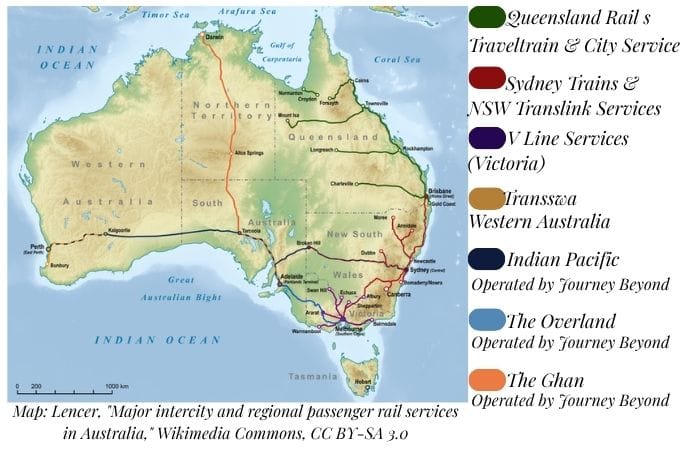
Two of Australia's most famous trains — the Indian Pacific and The Ghan — are not really transport at all. They are luxury tourism experiences, celebrated precisely because nobody actually needs to use them to get anywhere. Meanwhile, travelling between Brisbane, Sydney, and Melbourne by rail is often slower than driving. The Sydney-to-Melbourne XPT, introduced in the 1980s, is still in service. In Japan, you can travel that same distance — Tokyo to Osaka — in two and a half hours. In Australia, you're looking at eleven.
So how did a wealthy, modern country end up with a network that can hardly be called a national system?
A Model of Colonial Legacy
The short answer starts before Federation.
When the colonies began building railways in the nineteenth century, the goal wasn't to connect Australians to one another. It was to move resources, wool, grain, minerals from the interior to coastal ports. The lines radiated outward toward the sea, not toward each other.
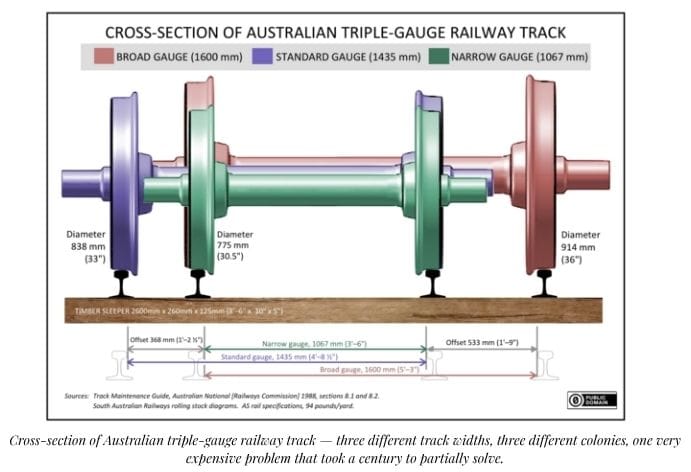
Compounding the problem, each colony chose its own track gauge. Victoria built broad gauge. Queensland built narrow gauge. New South Wales built standard gauge. For decades, trains literally could not cross state borders. Passengers and freight had to physically transfer between different trains at the state line, an arrangement that would be comical if it hadn't persisted in various forms well into the twentieth century.
Despite a century of effort, Australia's rail industry remains hampered by this
pre-Federation legacy. The country currently operates 29 separate rail networks, each with different standards, codes, and rulebooks.
The national government eventually standardised key interstate corridors, and the creation of the Australian Rail Track Corporation gave the country a federal infrastructure manager. But by the time those reforms arrived, the system had already evolved around state boundaries rather than national logic. The coordination problem didn't disappear. It just became more expensive to ignore.
The Broken Model
The consequences of that history are still playing out today.
As of December 2024, approximately 87 per cent of Australia's rail network is single-tracked. On a single-track line, a freight train and a passenger train cannot pass each other without one pulling over and waiting. That's not a metaphor for the system's dysfunction. It's a literal description of daily operations across much of the country.
Queensland's main passenger corridor heading north toward the Sunshine Coast illustrates the problem neatly. Sections of the line remain single track, forcing freight services to give way to passenger trains and vice versa. When both systems share limited infrastructure, both systems suffer: freight becomes slower and less predictable; passenger services can't expand to meet demand.
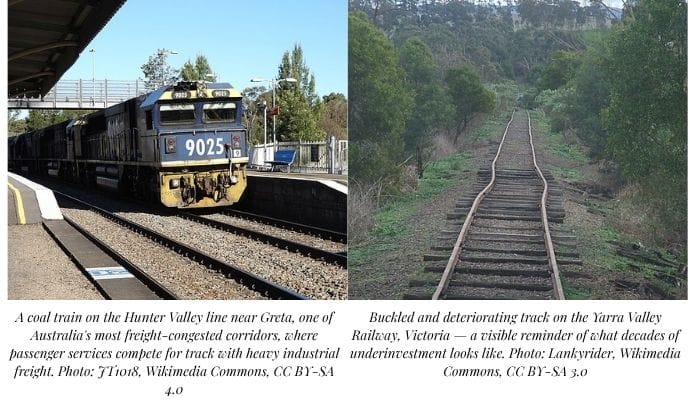
The pattern repeats across the country. Between late 2021 and early 2023, Australia's largest freight operator recorded eight interstate corridor shutdowns of a week or more. Each closure pushed freight onto highways, drove up costs, and exposed just how fragile a system becomes when there's no redundancy, no alternative route when one bridge washes out or one track buckles in the heat.
And it does buckle. Heat restrictions that slow Sydney trains have been imposed every summer for more than thirty years. In 2024-25, only 82.5 per cent of Sydney trains ran on time, well below the target of 92 per cent.
These aren't edge cases. They're the routine operating conditions of a system that was never really designed for what it's now being asked to do.
A Model Off The Rails
The Inland Rail project was supposed to fix the freight side of the equation.
The concept is straightforward: build a dedicated 1,600-kilometre freight spine between Melbourne and Brisbane, running inland through regional Victoria, New South Wales, and Queensland. Separate freight from passenger lines on the eastern seaboard. Cut freight transit times. Take 200,000 trucks a year off the highways.
The project started construction in 2018. It remains unfinished.
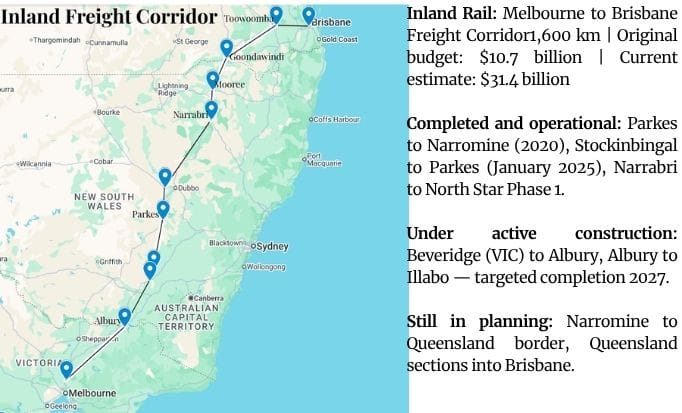
An independent review found the budget had blown out from an original estimate of $10.7 billion to approximately $31.4 billion and warned the final figure may climb further, because construction had commenced without anyone being certain where the line would actually start or finish. The review's author described the situation as "somewhat surprising" which, in the restrained language of infrastructure reports, is roughly equivalent to screaming.
As of late 2025, the section from Beveridge in Victoria to Parkes in New South Wales has been prioritised, with completion targeted for 2027. The future of the sections north of Parkes (the Queensland end of the project) remains subject to further government decisions.
To be clear: Inland Rail is still worth finishing. Most logistics professionals agree that without it, freight pressure on east coast highways will continue to rise, driver shortages will worsen, and exporters will remain vulnerable to bottlenecks they cannot control. The vision is sound. The execution has been a masterclass in how not to run a major infrastructure project.
Shiny New Models
Something has shifted in Australian urban rail. After decades of underinvestment, the country's major cities are finally building the kind of infrastructure that befits a wealthy, modern nation — and the results are genuinely transformative.
Melbourne led the way most recently. The Metro Tunnel opened ahead of schedule on 30 November 2025 — the biggest transformation of Melbourne's rail network in 40 years. Five new underground stations now connect the Sunbury, Cranbourne and Pakenham lines through the CBD, adding over 1,000 extra weekly services and finally resolving the notorious City Loop bottleneck that had constrained Melbourne's network for decades. Over 70,000 people turned up on opening day. The message was hard to miss, Australians actually want to use rail when trains are worth using.
Sydney has its own story, more complicated but no less significant. The intercity network is finally receiving new rolling stock after an embarrassingly protracted process, the Mariyung fleet (named from the Darug word for emu) is now operating on the Central Coast, Newcastle and Blue Mountains lines, replacing carriages that had been in service since the 1980s. Regional lines will follow with a new R-set fleet currently in testing, expected in service by 2027. Whether the new trains arrive before the patience of long-suffering regional passengers runs out entirely is another matter.
Brisbane's Cross River Rail (a 10.2 kilometre line with twin tunnels under the CBD delivering four new underground stations) is the most significant public transport investment in Queensland's history. The first passenger services are expected in 2029, having originally been promised by 2024 at a cost of $5.4 billion, with the final price tag landing at $19 billion. The delays and blowouts are genuinely frustrating. But the project itself (Brisbane's first new CBD station in over 120 years) will reshape how the entire southeast Queensland network functions once it opens.
These are real achievements. They represent billions of dollars of genuine commitment to public transport, and they will make daily life measurably better for millions of Australians in the cities where they've been built.
But here's the thing: every one of these projects is urban. Every single one serves capital city commuters. And every one of them throws into sharp relief what hasn't changed, the moment you step outside a major metropolitan area, you encounter a rail system that in some cases, hasn't been meaningfully upgraded since the 1980s.
The question Australia hasn't yet answered is whether the ambition that built Melbourne's Metro Tunnel and Brisbane's Cross River Rail can be extended, even partially, to the regional communities and intercity corridors that have been waiting far longer.
The infrastructure for that vision largely exists. The corridors are there. In some cases, the trains are finally arriving. What's been missing is the will to connect it all into something that actually functions as a national system.
A Model We Actually Deserve
Consider the Sydney to Melbourne air corridor for a moment.
It is one of the busiest domestic air routes on Earth: carrying over 9 million passengers a year and generating more revenue than almost any other airline route in the world. Not because the service is exceptional. Not because Australians are particularly enthusiastic flyers. But because they have no real choice.
The route is controlled by two airline groups — Qantas and Virgin — in what aviation economists describe straightforwardly as a duopoly. A third major carrier, the argument goes, simply cannot survive in a market this size. Bonza tried. Rex tried. Both are gone from major city routes. Experts say airfares are unlikely to fall significantly for the foreseeable future, the duopoly structure is essentially permanent given Australia's population size.
Australia has the second busiest air route in the world by daily flights, despite having fewer people than the state of Texas
The consequences are measurable. With the exit of smaller competitors, average real fare revenue per passenger on major city routes rose 13.6% between July and December 2024 alone. In November 2024, planes on metropolitan routes were running at 90.4% capacity, the highest load factor recorded since tracking began. The system isn't just expensive. It's full.
There is one thing that could fundamentally change this equation, and it isn't another airline. It's a train.
A genuine high-speed rail connection between Sydney and Melbourne, running at 300km/h on a dedicated corridor, would cover the distance in approximately three and a half hours. Add airport security and city centre convenience, and it becomes directly competitive with flying for most travellers. The moment that alternative exists, the Qantas-Virgin duopoly loses its grip on the most lucrative domestic route in the country. Fares fall. Planes free up capacity for routes that rail can't serve. Airports breathe. And Australians stop paying a private tax on the absence of a public option.
The High Speed Rail Authority, established by the federal government in 2023, submitted a full business case in December 2024. The projected economic benefit: $250 billion by 2086. The projected carbon saving: 86,000 tonnes of emissions annually. The first stage (Sydney to Newcastle) in approximately one hour, received a positive assessment from Infrastructure Australia in late 2025. The project is real. It is moving. It will take decades and cost an enormous amount of money. But for the first time in a generation, Australia has committed serious institutional energy to treating the eastern seaboard as a single transport system rather than a collection of state problems.
And here is the crucial point that rarely makes it into the public debate: Australia does not need to build most of this from scratch. The corridors already exist. The land is already cleared. The rights of way are already secured. What the country needs is not a blank canvas. It’s the will to upgrade, duplicate, and coordinate what it already has.
The freight network that carries coal and grain across the continent is, in most cases, running on the same corridors that passenger trains would use. Separating them and giving freight its own dedicated spine via Inland Rail, and freeing the coastal corridors for upgraded passenger services, is the foundational move that unlocks everything else. It doesn't require reinventing the map. It requires deciding to use the map properly.
There is also a workforce question that rarely gets asked loudly enough. Australia is about to spend an extraordinary amount of money on rail infrastructure. The Inland Rail alone, even at its battered current budget of $31 billion, represents one of the largest construction projects in the country's history. The Metro Tunnels, the Cross River Rail, the new rolling stock programs together, these represent a generational investment in rail capacity. And yet Australia does not currently have the engineering workforce, the project management expertise, or the specialist rail construction capacity to deliver all of it at the scale required.
Other countries have built that expertise over generations — in Japan, France, Spain, the UK, and across Southeast Asia. A targeted skilled migration pathway for rail engineers, tunnel specialists, signalling experts, and project managers is not a radical idea. It is infrastructure planning 101.
Attempting to deliver a $50 billion rail program with an undersized domestic workforce is precisely the kind of thing that turns a $10 billion project into a $31 billion one.
Australia doesn't lack ambition anymore. The business cases are being written. The authorities are being established. The money, slowly and grudgingly, is being committed. What the country needs now is the execution discipline to match the vision. That means long-term funding certainty beyond electoral cycles. It means procurement that rewards competence over the cheapest tender. It means treating rail not as a series of state projects but as a national system with a national strategy.
The United States (hardly a country known for its public transport) still maintains Amtrak connections between its major cities and operates the most profitable freight rail network on Earth. The secret is not technology. It is not geography. It is the decision, made long ago and never fully abandoned, that options matter. That a country functions better when its people and its goods can move through it efficiently, by more than one means.
Australia made different decisions. It can make different ones again.
The Model We've Been Missing
Australia has never lacked railways. It has never lacked the land, the resources, or the engineering capacity to build them. What it has lacked, consistently, expensively, and at great cost to the people who live beyond the major cities is the willingness to treat them as a system.
The story of Australian rail is not really a story about trains. It is a story about decisions. Decisions made by colonies that prioritised ports over people. Decisions made by states that prioritised their own borders over national connectivity. Decisions made by governments that prioritised the next election over the next generation. And decisions not made the plans shelved, the corridors left dormant, the regional communities quietly written off as too small, too far, too expensive to matter.
The cost of those decisions is now visible everywhere. In the Sydney commuter paying hundreds of dollars to fly to Melbourne because the train takes eleven hours and arrives on time less than a third of the time. In the freight operator rerouting trucks onto highways because the rail line washed out and there is no alternative. In the regional town that watches its young people leave because the connections that would make staying viable were never built.
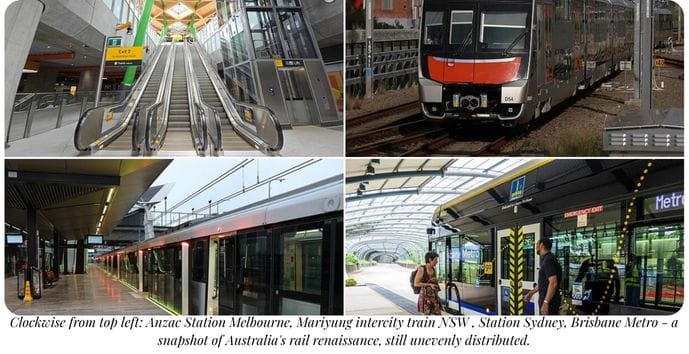
But something is shifting. Slowly, imperfectly, and with the usual Australian combination of ambition and dysfunction, something is actually moving. The tunnels are being dug. The new trains are arriving. The business cases are being written and for once, being taken seriously. The infrastructure that already exists: the corridors, the rights of way, the freight spines that cross the continent, are finally being looked at as the foundation of something rather than the relic of something. The model was never missing the map. It was missing the will.
That is the thing that can change. And there are signs, tentative, fragile, but real, that it finally is.
Update — May 2026:
Since this piece was published, the Albanese government has announced it will not complete the Melbourne-Brisbane inland rail corridor. The project, originally costed at $9.3 billion in 2017, has blown out to over $45 billion. Construction will now only proceed to Parkes in central NSW — roughly 1,000 kilometres short of Brisbane. The $1.75 billion saved is being redirected to upgrade the existing east coast freight network. We stand by our original argument: Australia's rail infrastructure deserves better than this.

Systems & Signals
Hemp: The Little Plant that Could
Once Upon a Time...
There is a plant so versatile, so useful, and so ancient that humanity has been growing it for over 10,000 years. It fed us, clothed us, built our shelters, sailed our ships, and wrote our stories — quite literally. The American Declaration of Independence was drafted on hemp paper. The ropes and sails that carried the First Fleet to Australia were made from hemp fibre. Sir Joseph Banks, the botanist who came ashore at Botany Bay in 1770, was so convinced of the plant's potential that some historians believe the colonisation of Australia was motivated not by the need to relocate convicts, but by Britain's desperate need for a new hemp supply after losing its American colonies.
For 150 years, early Australian governments actively encouraged hemp farming — handing out land grants, subsidies, and seed stock to anyone willing to grow it. Cannabis cigarettes were sold over the counter at Australian pharmacies well into the twentieth century, marketed as a reliable treatment for asthma, bronchitis, and hay fever.
And then, in 1937, like magic it was gone.
Not because of science. Not because of evidence. But because an American newspaper magnate named William Randolph Hearst owned vast timber forests and paper mills and did not welcome the competition. Because the DuPont chemical company had just patented nylon and needed hemp out of the market. Because the United States Federal Bureau of Narcotics ran a propaganda campaign so effective it convinced most of the Western world that this ancient, useful, entirely non-psychoactive industrial crop was a dangerous drug, and Australia, ever the loyal ally, followed suit within the year.
Hemp was banned in Australia in 1937. It wasn't fully legalised for food use until 2017. That's eighty years of one of the most useful plants on Earth sitting in a paddock doing nothing, because of a lie told by people who stood to profit from it.
Right. Now that we've got that off our chest, let's talk about what this remarkable little plant can actually do. Because the list, it turns out, is rather extraordinary.
The Emperor's New Threads: Hemp Fibre
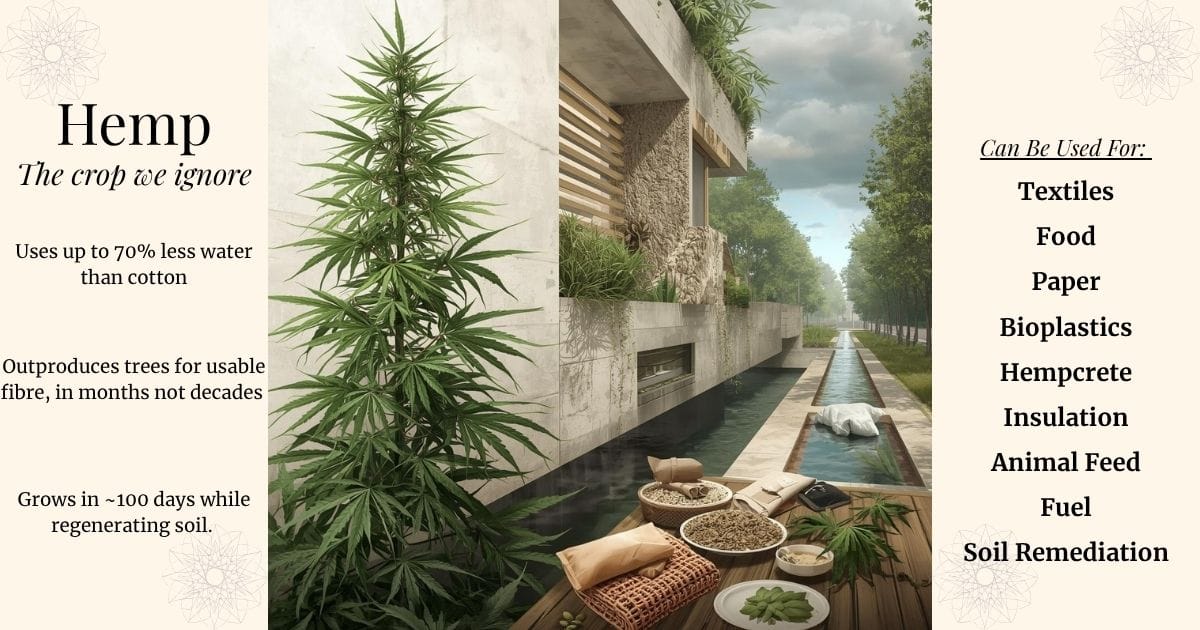
Hemp fibre is one of the strongest natural fibres on Earth — stronger than cotton, more durable than linen, and softer with every wash rather than wearing out. It has been used to make rope, canvas, clothing, and industrial textiles for thousands of years. The word "canvas" itself derives from "cannabis." Global hemp fibre production now exceeds 200,000 tonnes annually and the market is projected to surpass $30 billion by 2033.
The environmental case against cotton is stark. Despite covering only 2.5% of the world's agricultural land, cotton accounts for 16% of global insecticide use, making it one of the most chemically intensive crops on the planet. It is also extraordinarily thirsty, requiring approximately 10,000 litres of water to produce a single kilogram of fibre. Hemp requires less than 2,800 litres for the same yield. Roughly 70% less water. Virtually no pesticides. And it improves the soil it grows in rather than degrading it.

But here is where the comparison becomes genuinely interesting. A cotton crop yields one product, cotton lint. A hemp fibre crop grown on the same land yields three. The outer stalk produces bast fibre for textiles and rope. The woody inner core, the hurd, goes to construction materials or bioplastics. The remaining biomass becomes fuel. The leaves return to the soil as organic matter. And when the crop is done, the land is in better condition than when the season started, more aerated, less compacted, richer in organic content, ready for whatever comes next in the rotation.
Cotton leaves the land worse than it found it. Hemp leaves it better. That is not a marginal difference in farming practice. That is a fundamentally different relationship between agriculture and the earth it depends on.
Building The Kingdom: Hempcrete
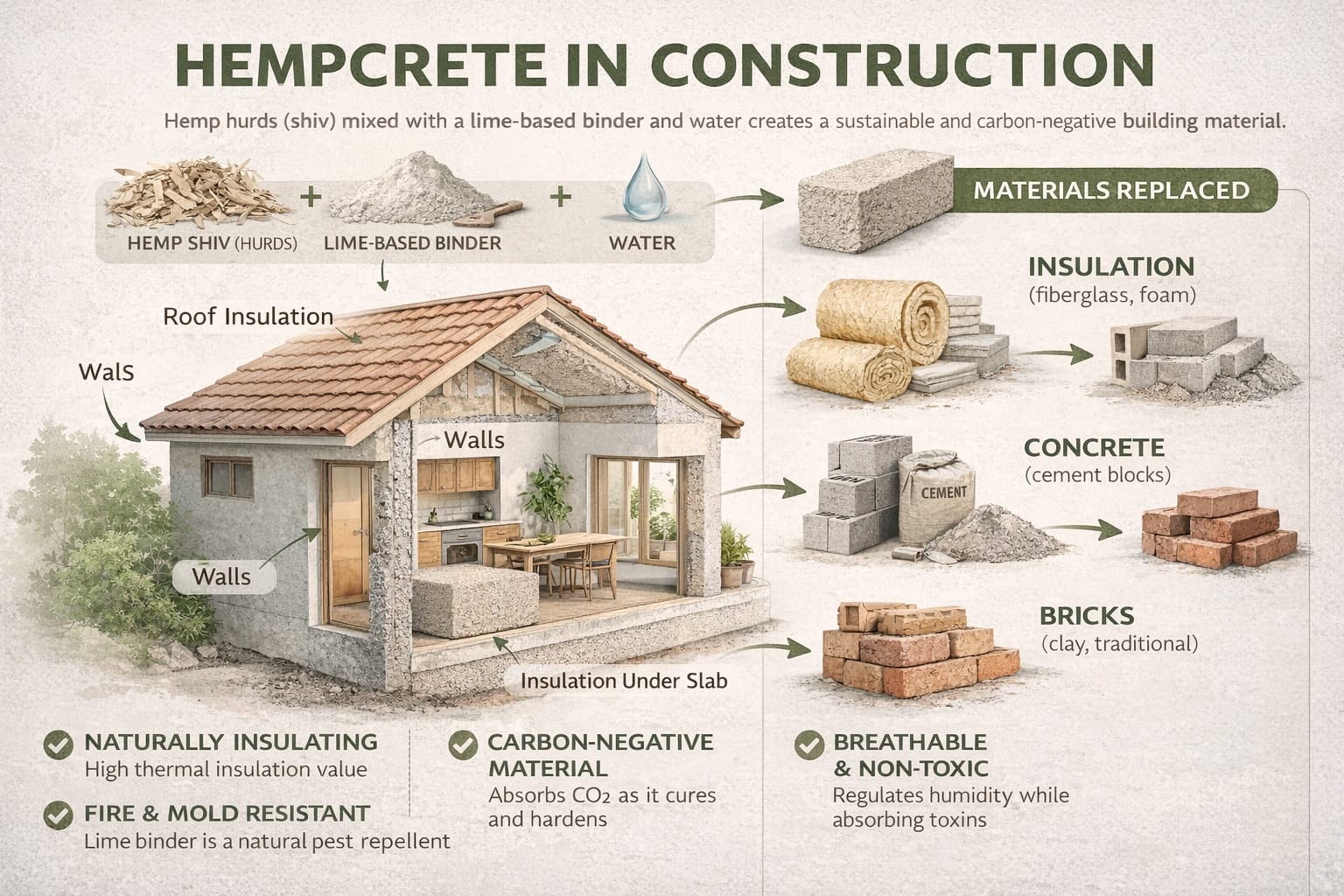
Concrete is responsible for approximately 8% of global CO₂ emissions annually, and unlike almost every other building material, it continues emitting long after construction is complete. Hempcrete does the opposite. Made from hemp hurd (the woody inner core of the stalk) mixed with a lime-based binder, hempcrete actively absorbs carbon as it cures and continues doing so for up to 100 years after the building is finished. One hectare of hemp used in hempcrete production sequesters approximately 15 tonnes of CO₂. The building material that fights climate change while you sleep in it.
And here is the part the concrete industry would prefer you didn't think about too hard. The same crop that produced the hurd for your hempcrete walls also produced bast fibre for textiles from its outer stalk, and biomass for fuel from what remained. A pine forest cleared for timber gives you one product and leaves degraded monoculture land behind. A hemp crop gives you a building material, a textile fibre, and fuel, grown in four months, on land that is measurably healthier when the harvest is done.
A Different Kind of Alchemy: Bioplastic
Plastic is everywhere, in everything, and in everyone: microplastics have now been found in human blood, lungs, and breast milk. The world produces over 400 million tonnes of plastic annually, almost all of it derived from fossil fuels, and almost all of it destined to persist in the environment for hundreds of years after it has served its purpose. Hemp bioplastic tells a fundamentally different story. Made from hemp cellulose and seed oil, it is biodegradable, renewable, and produces significantly lower carbon emissions in manufacture than any petroleum-based alternative.
This isn't science fiction; it's already in production. Henry Ford famously built a car body from hemp composite in 1941, reportedly stronger than steel. Today, hemp-derived materials are used in automotive interiors, packaging, and industrial components. And here is the part worth sitting with: the cellulose for your bioplastic comes from the same crop that produced bast fibre for textiles and hurd for hempcrete. The seed oil for bioplastic comes from seeds that also feed people. Petroleum plastic provides one product and leaves a 500-year legacy of environmental contamination. Hemp gives you packaging, building materials, clothing, and food from a single harvest, on land that improves with every growing season.
Turning the Page: Paper & Pulp
Hemp has been used for paper since at least 105 AD in China. Gutenberg's Bible was printed on it. The first two drafts of the American Declaration of Independence were written on it. The ropes and sails that carried the First Fleet to Australian shores were woven from it. For most of recorded human history, hemp was not a controversial plant — it was simply an extraordinarily useful one.
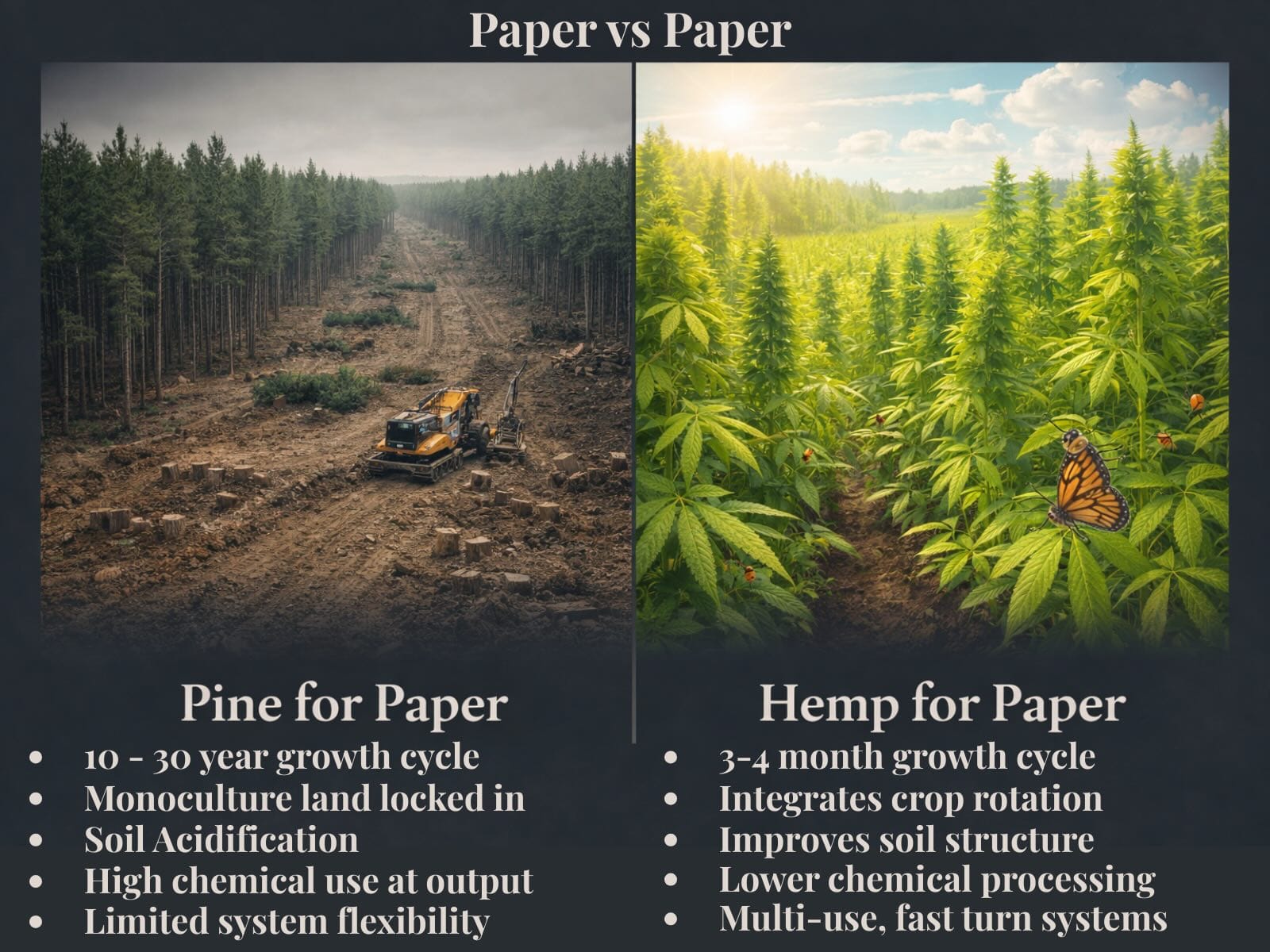
The graphic above tells the modern story plainly enough. A pine plantation grows for up to thirty years, locks agricultural land into monoculture for that entire period, acidifies the soil beneath it, and yields one product, pulp. A hemp crop grown on the same land reaches harvest in four months, improves the soil it grew in, and yields paper pulp from its hurd, bast fibre for textiles from its outer stalk, and biomass for fuel from what remains. Then land goes back into rotation, healthier than it started.
We are still primarily cutting down trees for paper in 2026. Not because hemp paper is inferior, it isn't. Because the industrial infrastructure for wood pulp was built before hemp was banned, and never been seriously challenged since. It’s not a market verdict. It’s institutional inertia, and it is costing us forests we cannot afford to lose.
A Green Remedy: Soil Regeneration and Photoremediation
Most commercial crops are a transaction; they take nutrients and biological richness from the soil and return very little. Hemp does the opposite. Its deep root system aerates compacted soil, suppresses weeds without herbicide, prevents erosion, and deposits organic matter that measurably improves whatever crop follows it in rotation. It thrives in marginal land where other crops fail. It requires minimal fertiliser. And when the harvest is done, the land is in better condition than when the season started.
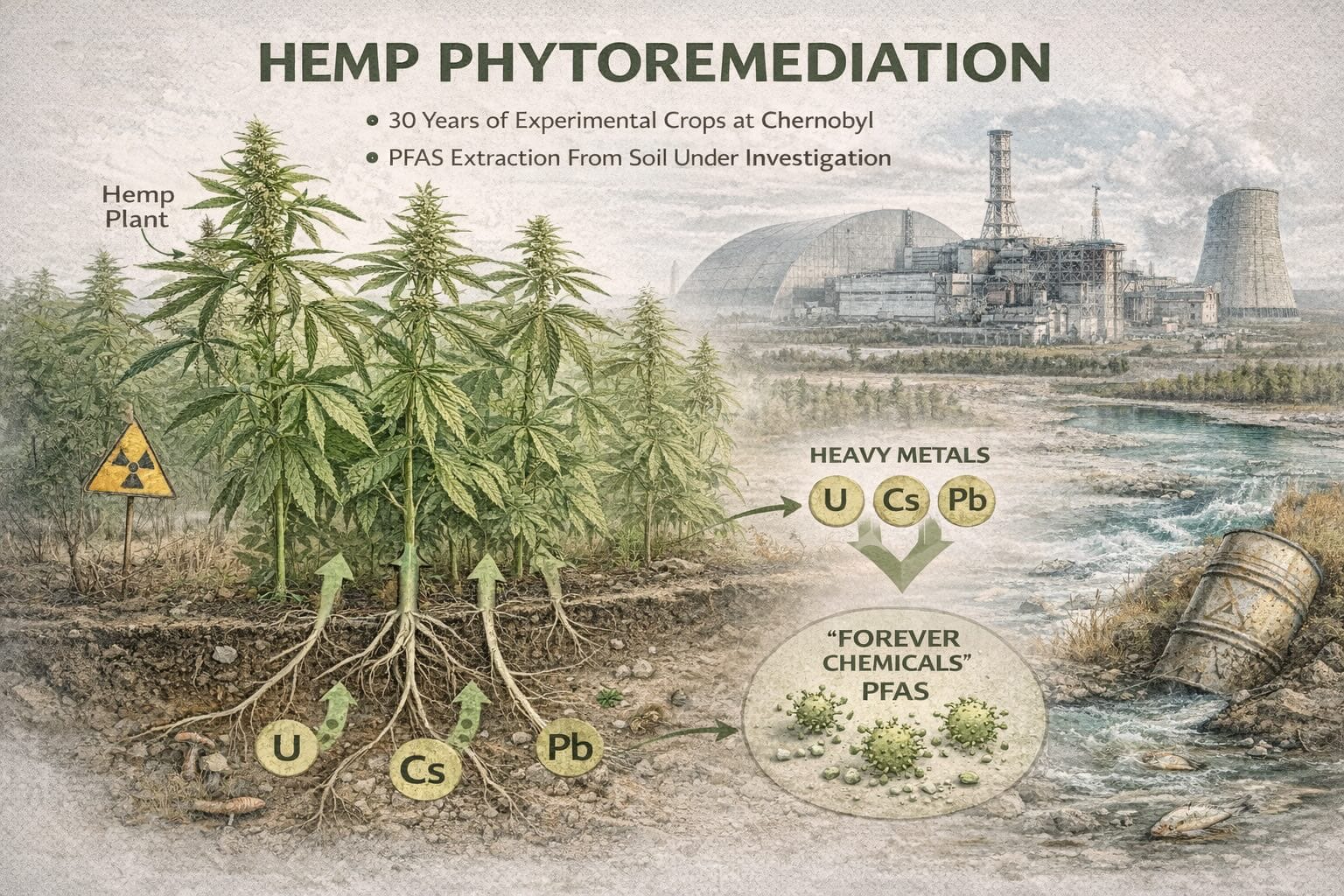
But the soil story doesn't stop at crop rotation. Since 1998, hemp has been planted deliberately in the fields surrounding Chernobyl (the site of the worst nuclear disaster in human history) to draw radioactive contaminants and heavy metals from the soil through its root system into harvestable biomass. Multiple peer-reviewed studies have confirmed hemp's ability to extract lead, cadmium, nickel, and caesium from heavily contaminated land. The radioactive isotope research is ongoing and promising; we'll say what the evidence supports and no more. What is beyond dispute is that the same principle is now being actively investigated for PFAS removal, those forever chemicals that have contaminated farmland and water supplies across Australia, including around defence sites. The contaminated biomass, unsuitable for food or fibre, gets converted to biofuel. You grow a crop. You clean the land. You generate energy from what you harvest.
It is, inexplicably, the same plant.
Seeds of Plenty: Food
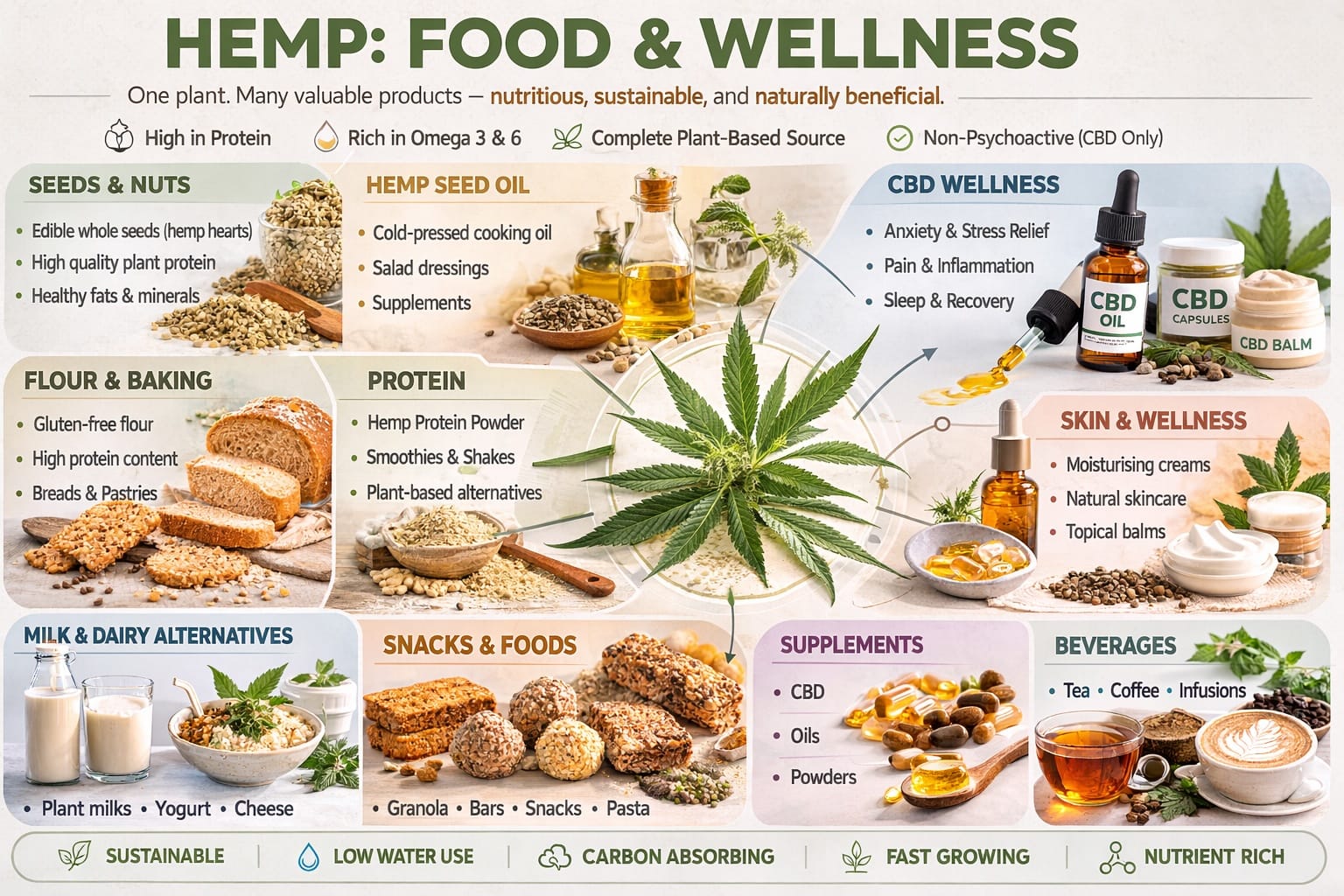
Hemp seeds are one of the most nutritionally complete foods available from a single plant source. They are around 30% plant protein, contain the full suite of essential amino acids, are approximately 50% fat, and nearly 80% is polyunsaturated, rich in vitamin E, B-group vitamins, phosphorus, potassium, magnesium, and iron. For those following a plant-based diet, hemp seeds solve several nutritional problems simultaneously: complete protein, essential fatty acids, and a broad mineral profile in one ingredient.
The omega fatty acid profile deserves particular mention. Hemp seeds contain omega-3 and omega-6 in an approximately 3:1 ratio, considered close to optimal for human health, supporting cardiovascular function, brain health, and inflammation regulation. They are also free from gluten, dairy, and common allergens, making them accessible to people who struggle with most other protein sources. In Australia, hemp was only legalised for human consumption in 2017, meaning this nutritional powerhouse sat on the shelf for eighty years while we imported inferior alternatives. Hemp seeds, hemp oil, hemp flour, and hemp protein powder are now available in major supermarkets. They have always deserved to be there.
Industrial hemp contains CBD, the non-psychoactive cannabinoid, in meaningful concentrations. The evidence base for CBD is strongest for specific epilepsy conditions, where it is the basis for an FDA-approved pharmaceutical. Anti-inflammatory and anxiety-related applications show promise in emerging research, though the science is still developing.
Bottled Sunlight: BioFuel
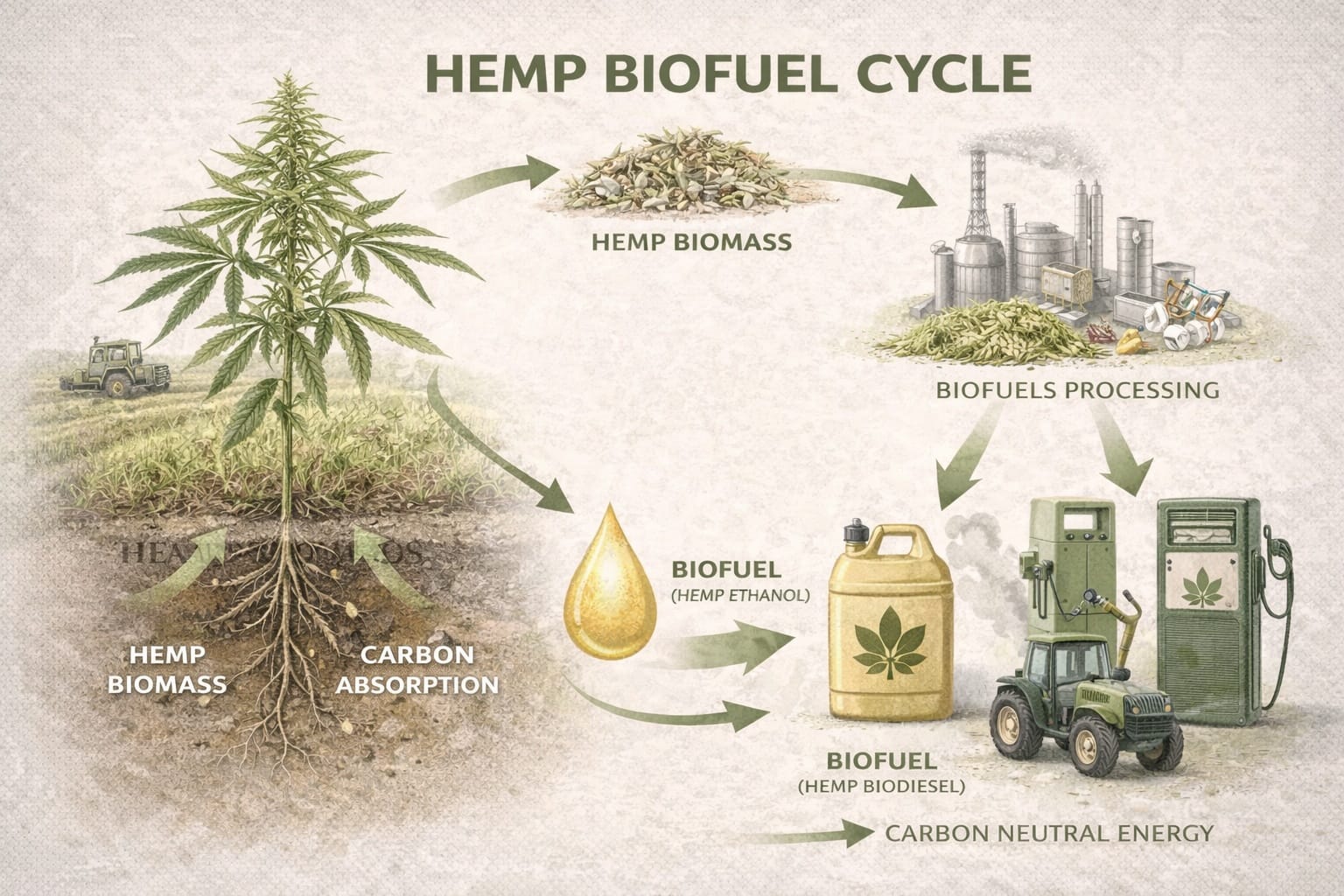
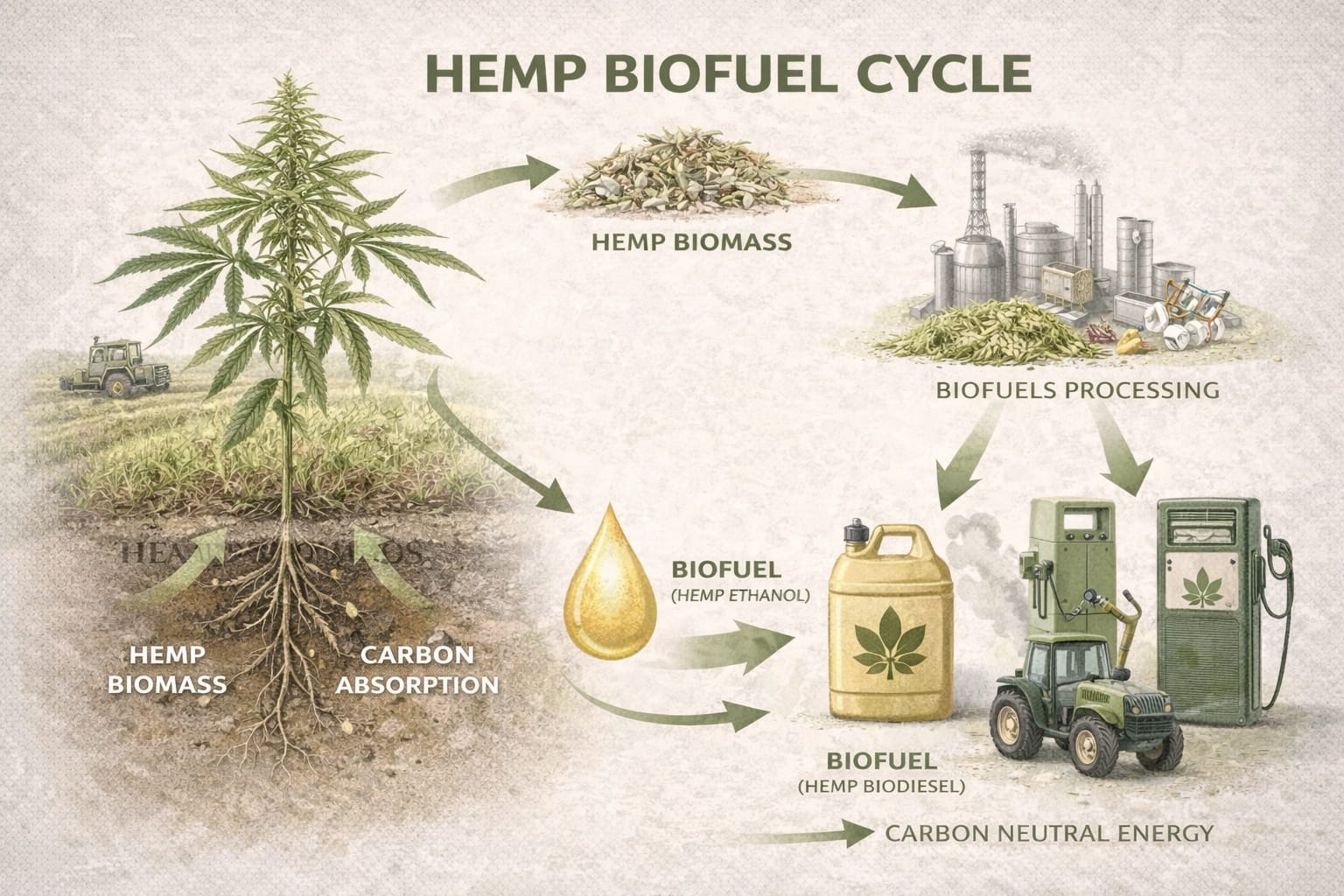
The global energy transition is, at its core, a problem of replacing fossil fuels with something that can do the same job without the consequences. Hemp biofuel is not a silver bullet, no single crop is, but it represents a genuinely viable part of a diverse renewable energy portfolio. Hemp can be converted into biodiesel from its seed oil, bioethanol from its cellulose, and biogas through anaerobic digestion of its biomass. Hemp harvested under optimal conditions yields up to 246 gigajoules of energy per hectare per year: approximately 120% of the energy yield of wheat straw grown under equivalent conditions.
What makes hemp particularly interesting as an energy crop is the pairing opportunity with soil remediation. Contaminated hemp biomass i.e. plants grown specifically to draw toxins from polluted land, can be harvested and converted to biofuel rather than simply disposed of. The contaminated biomass can then be processed through pyrolysis rather than simple combustion, a controlled thermochemical process which extracts energy while capturing contaminants rather than releasing them into the atmosphere. Studies show this approach can generate primary energy savings of up to 36 gigajoules per hectare while avoiding over 600 kilograms of CO₂ equivalent emissions per remediated hectare. You clean the land. You power the grid. The plant does both. It is almost annoyingly efficient.
Happily Ever After:
Here is what an industrialised hemp economy could look like for Australia.
Cotton currently uses 6 to 7 megalitres of irrigation water per hectare in the Murray-Darling Basin, one of the most stressed river systems on Earth, an ecosystem that produces 41 per cent of Australia's agricultural output and is currently in a state of slow ecological collapse from over-extraction. Hemp's water footprint is less than one-third of cotton's 2,719 litres per kilogram, compared to cotton's 10,000 litres per kilogram. Its irrigation requirement is 84 per cent lower, and its overall irrigated water footprint 91 per cent lower.
That is not a marginal improvement. That is a transformation. Every hectare of cotton replaced by hemp in the Murray-Darling Basin returns an extraordinary volume of water to a river system that is running out of it. Water that currently irrigates a single crop for export returns to wetlands, to ecosystems, to the communities downstream who depend on it. The Darling River does not have to keep running dry so that cotton can be shipped overseas.
And that is just one crop, on one application.
Scale hemp across its full industrial range — fibre replacing cotton and synthetic textiles, hurd replacing timber in construction and paper manufacturing, seeds displacing less nutritious and more resource-intensive protein sources, bioplastic replacing petroleum packaging, remediation crops cleaning contaminated land while generating energy — and you begin to see the shape of something genuinely different. An agricultural system that gives back more than it takes. A manufacturing base built on a crop that grows in four months, improves the land it grows on, requires minimal chemical inputs, and sequesters carbon while it does all of the above.
Australia has the climate, the land, the agricultural expertise, and the research capacity to become a world leader in industrial hemp. It has the coastline to export finished products. It has the domestic demand to absorb them. What it has lacked until very recently is the legal permission to try.
That permission now exists. The industry is small but growing. The research is solid. The economics, as scale increases, become increasingly compelling. The only thing standing between Australia and a hemp economy that would make the country wealthier, its rivers healthier, its buildings more sustainable, and its farmers less dependent on a climate that is becoming less predictable every year is the willingness to take it seriously.
This is not a fairy tale. The plant is real. The science is real. The opportunity is real.
It is simply a matter of choosing to use it.

Culture & Media
Three thousand years after Homer wrote it, Christopher Nolan brings The Odyssey to IMAX. In cinemas July 17, 2026.
The Real Neverending Story - The Iliad and The Odyssey
"After years of war... no one could stand between my men and home... not even me" - Odysseus
Three thousand years ago, a blind poet, or possibly several poets, or possibly no poet at all, depending on which classicist you ask, told a story about a man trying to get home. It had monsters and gods, treachery and loyalty, a faithful wife holding off an island full of suitors for twenty years, and a hero who was brilliant and brave and deeply, frustratingly human. It was passed down orally for generations before anyone wrote it down. The first printed Greek version appeared in 1488. It has never, in three millennia, gone out of print.
This July, Christopher Nolan is going to put it on an IMAX screen. And based on everything we know so far, the chills are entirely justified.
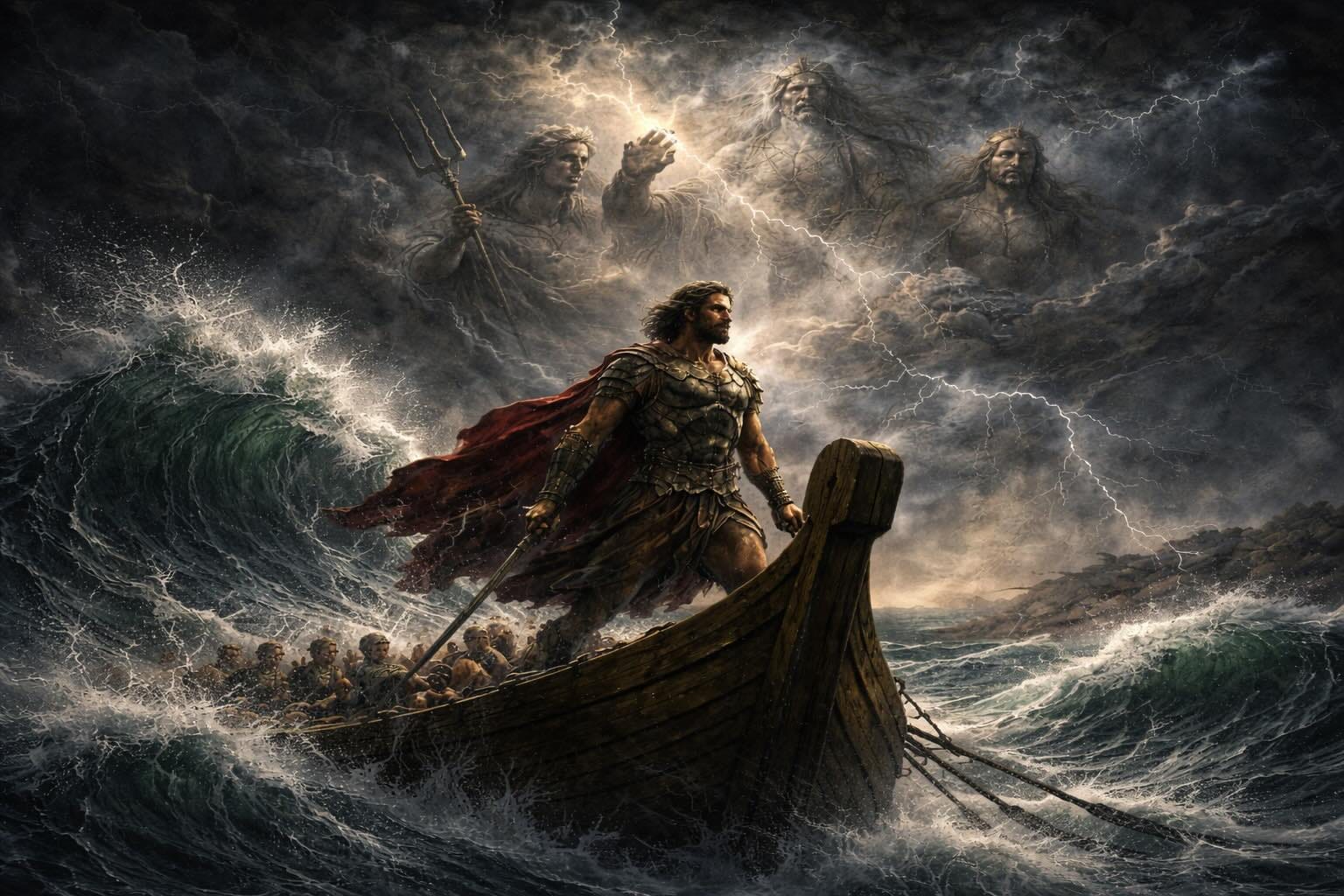
Nolan began writing The Odyssey in March 2024, fresh off Oppenheimer's seven Academy Awards, including Best Picture and Best Director. He had, by any measure, earned the right to make whatever he wanted next. What he wanted was Homer. "When you start to break down the text and adapt it, you find that all of these other films, and all the films I've worked on, they're all from the Odyssey. It's foundational."
The production is, by any measure, extraordinary. With a budget of $250 million, the largest of Nolan's career, The Odyssey is the first feature film ever shot entirely on IMAX 70mm film cameras. Filming ran from February to August 2025 across Morocco, Greece, Sicily, Iceland, Scotland, Ireland, Western Sahara, and Los Angeles. Over two million feet of film were used. The cinematographer is Hoyte van Hoytema, returning for his fifth film with Nolan. The composer is Ludwig Göransson, who won the Oscar for Oppenheimer. The editor is Jennifer Lame. This is not a director going through the motions. This is a filmmaker assembling his best team for what he clearly believes is the most important story he has ever told. Tickets for the opening weekend went on sale in July 2025, a full year before release. Half of the 22 available US IMAX 70mm theatres sold out within 12 hours. The Odyssey was subsequently ranked the most anticipated film of 2026 by IMDb. Variety has predicted it could become the highest-grossing film of the year and potentially Nolan's biggest box office hit ever. ensemble reads like someone was given an unlimited budget and told to cast the best working actors alive, because that is essentially what happened.
The Cast
The ensemble reads like someone was given an unlimited budget and told to cast the best working actors alive, because that is essentially what happened.
Matt Damon leads as Odysseus, the cunning, complicated, deeply mortal king of Ithaca. Anne Hathaway plays Penelope, his wife who has been holding the kingdom together for twenty years. Tom Holland is Telemachus, the son who barely knows his father. Robert Pattinson plays Antinous, the lead villain among the suitors. Charlize Theron is Circe, the sorceress. Zendaya is Athena. Lupita Nyong'o, Jon Bernthal, Mia Goth, Elliot Page, John Leguizamo, Himesh Patel, Benny Safdie and Samantha Morton round out a cast that genuinely has no weak links.
Holland and Zendaya (real-life couple), recently reunited on screen in Spider-Man, are back together again, this time as mortal hero's son and goddess of wisdom. The internet has already decided this is delightful.
The Unconfirmed Scoop
Here's the bit the trades reported but nobody has officially confirmed: Nolan reportedly wanted Robert Downey Jr. for the role of Poseidon, god of the sea, Odysseus's divine nemesis, but scheduling couldn't be worked out because Downey was already committed to Marvel's Avengers: Doomsday. The role reportedly went to someone else. Who exactly is playing the god who spent ten years trying to drown our hero remains officially unannounced.
Also worth noting for the curious: Travis Scott appears in the film, seen in the trailer delivering the line "A war, a man, a trick to break the walls of Troy and burn it straight into the ground." His character remains unconfirmed. Your guess is as good as ours.
The Creative Approach
The detail that separates this from every previous Odyssey adaptation is Nolan's decision about the gods. Rather than depicting Zeus and Poseidon as literal divine figures throwing lightning bolts, Nolan chose to depict divine intervention through natural phenomena, storms, earthquakes, and strange tides that ancient people would have understood as supernatural but which we now recognise as the world simply being the world. He called it a "big breakthrough creatively." It grounds the story in a reality that makes it feel both ancient and completely contemporary.
The other significant creative choice is the source text. Emily Wilson's 2017 translation of the Odyssey (the first English translation by a woman in the poem's entire history) was a key influence on Nolan's approach. Wilson's Odysseus is morally ambiguous, cunning, and deeply human rather than a straightforward hero. That is exactly the kind of character Nolan has always been drawn to. Complicated men doing complicated things for reasons that resist simple judgment. Oppenheimer. Bruce Wayne. Odysseus. The pattern holds.
Why Now?
The question worth asking is why this story, this film, this moment.
The Odyssey is, at its core, a story about a man who wants to go home and cannot. About the cost of war extending far beyond the battlefield. About loyalty tested across decades of absence. About the gap between who we were when we left and who we are when we finally return. About the gods — or fate, or circumstance, or the grinding indifference of the universe — making the journey as hard as possible for reasons that feel arbitrary and cruel.
It is not difficult to see why that story resonates in 2026.
The Odyssey opens in theatres and IMAX worldwide on July 17, 2026. We will be there.

From the Librarium
The Odyssey - Homer circa 8th century BC
Nobody knows who Homer was.
That is not a provocation, it’s simply the honest starting point for one of the most extraordinary documents in human history. The ancient Greeks themselves debated whether Homer was one person or many, whether he was blind, and whether he existed at all. What we know is that sometime around the 8th century BC, an epic poem about a man trying to get home after a long and terrible war was written down for the first time and that it had almost certainly been told aloud, passed from singer to singer across generations, for centuries before anyone committed it to papyrus.
"Sing to me of the man, Muse. The man of twists and turns." — Homer
The Odyssey is the story of Odysseus, King of Ithaca, and his ten-year journey home after the fall of Troy. He has already been away at war for ten years. He will spend another ten at sea, delayed by gods, monsters, sorcerers, and his own complicated nature, before he finally reaches the island and the family he has been trying to return to.
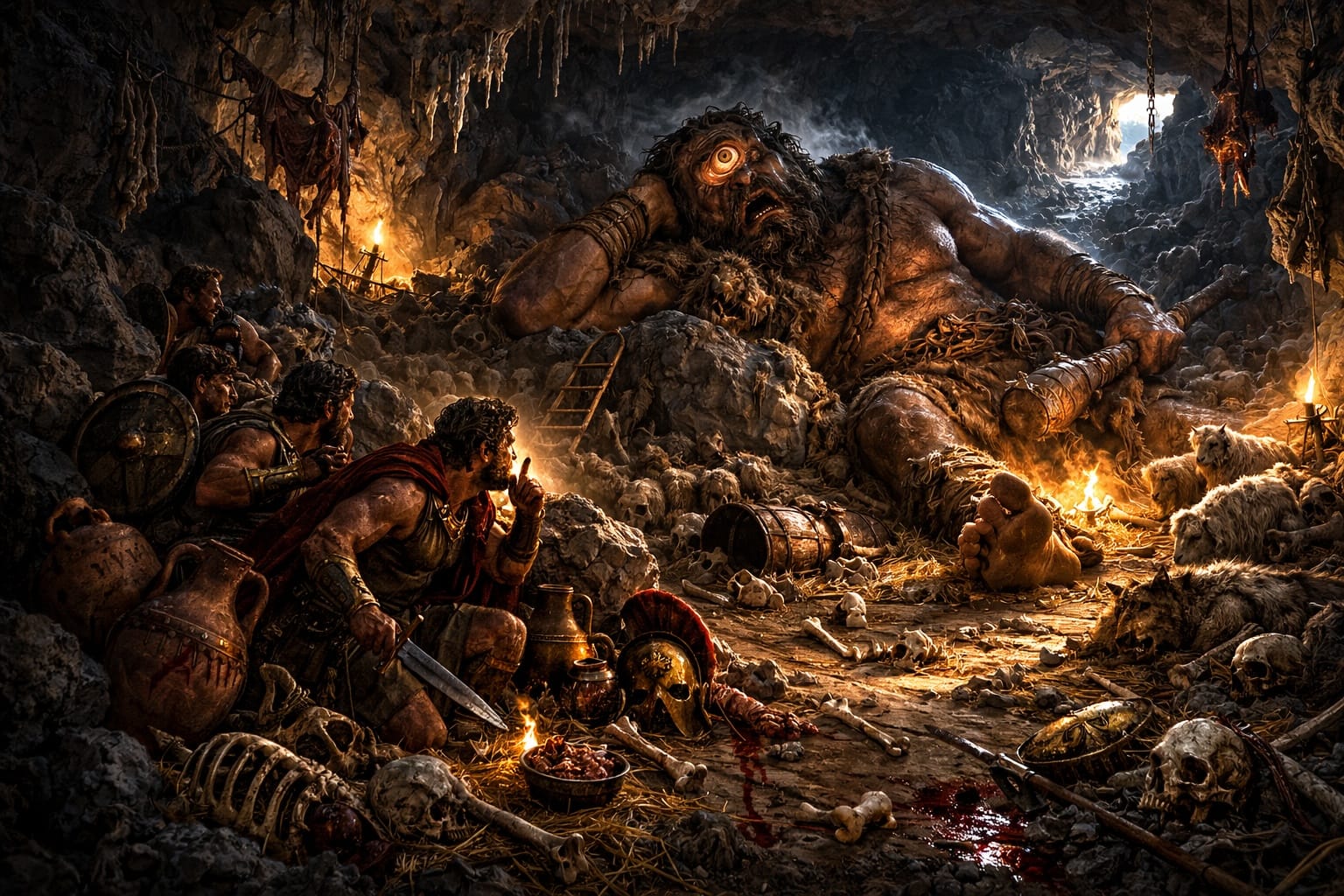
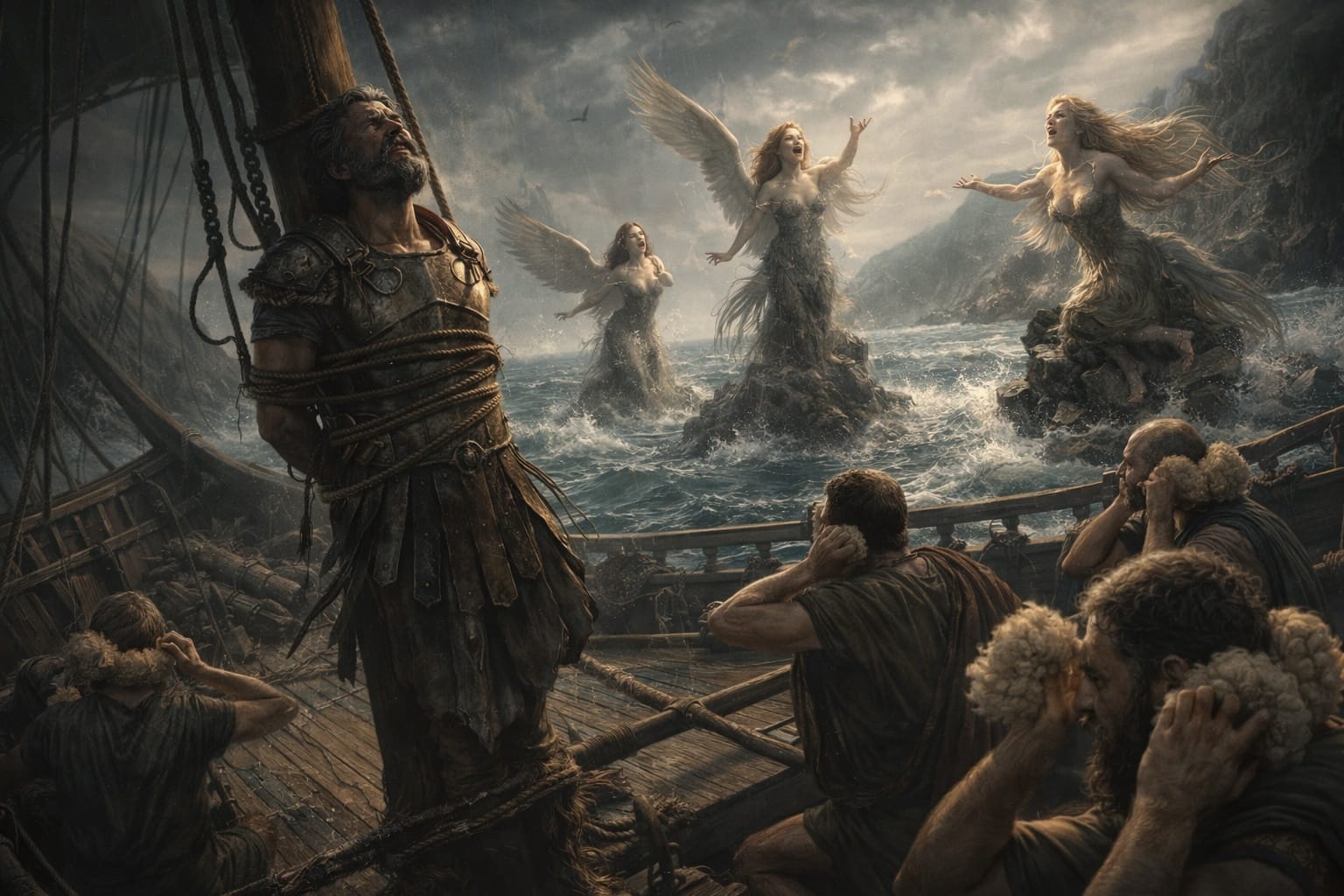
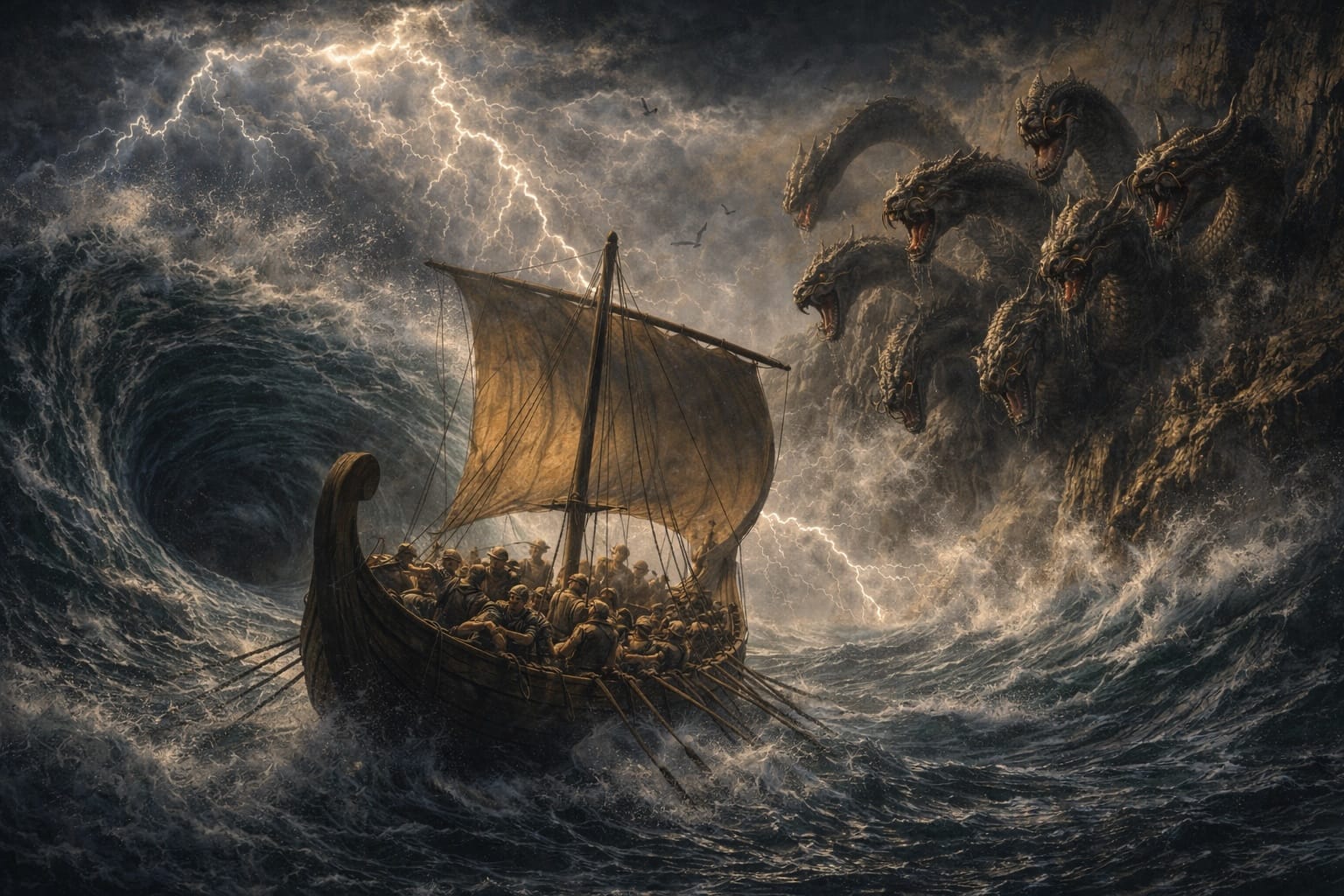
On the way, he encounters the Cyclops Polyphemus, the one-eyed giant son of Poseidon, whose blinding at Odysseus's hands earns the hero the god's undying wrath and explains most of his subsequent suffering. He passes through the island of Circe, the sorceress who turns men into animals and becomes his lover and guide. He sails between Scylla, the six-headed monster and Charybdis, the whirlpool, losing men to both. He visits the underworld to consult the dead. He resists the Sirens, those winged creatures whose song promises knowledge and delivers death, by having himself lashed to the mast while his crew rows past with wax in their ears.
He arrives home in disguise, to a palace full of suitors competing for his wife Penelope's hand, his kingdom effectively under siege. His faithful dog Argos, old, neglected, lying on a dung heap at the palace gates, recognises him immediately. Wags his tail once. And dies. Having held on, apparently, just long enough.
If that doesn't get you, nothing will.
"Even his griefs are a joy, long after, to one who remembers all that he wrought and endured."
Penelope has been holding the suitors off for years through an act of quiet genius, weaving a funeral shroud by day and unravelling it by night, telling them she will choose when it is finished. Telemachus, the son who barely knew his father, has grown into a young man searching for a hero he has never met. And Odysseus, cunning, complicated, flawed, deeply human, finally strings the bow that only he can string, and takes back what is his.
Why It Endures
The Odyssey has never gone out of print. It has been translated into every major language, adapted into films, novels, operas, comics, and video games. James Joyce built Ulysses around its structure. The Coen Brothers made O Brother Where Art Thou from it. Christopher Nolan is about to spend $250 million putting it on an IMAX screen.
It endures because it is not really about monsters or gods or ancient Greece at all. It is about the gap between who you were when you left and who you are when you return. About the cost of absence, to the person who left and to everyone waiting. About loyalty tested across decades. About a woman holding a kingdom together through intelligence and patience while everyone around her assumes she cannot. About a son becoming a man in his father's shadow. About a man who has seen and done terrible things, trying to find his way back to something worth returning to.
It is, in other words, about being human, which is presumably why it has lasted three thousand years and shows no signs of stopping.
Which Translation
For most of that three thousand years, English translations of the Odyssey were made exclusively by men. In 2017, classicist Emily Wilson became the first woman to translate it into English and the result is widely considered the finest translation available. Wilson's Odysseus is morally ambiguous, her language direct and contemporary without being anachronistic, and her translator's note alone is worth reading as an essay on how language shapes the stories we inherit.
It is free in the public domain in older translations; we have Robert Fagles' celebrated 1996 version available in the Bibliotheca now. Emily Wilson's 2017 translation is still under copyright and worth every cent of the purchase price.
The Odyssey is available now in the Atlas Librarium.
Projects & Progress
WeRise — A Nation Worth Building
Australia is, by almost any measure, one of the luckiest countries on Earth. Vast land, extraordinary natural resources, a stable democracy, world-class universities, and a standard of living that most of the planet can only imagine. We have the wealth, the space, and the talent to build almost anything we choose.
So why does it feel like we keep choosing so little?
WeRise is Atlas Media's policy platform — and its most ambitious project. It is not a political party. It is not affiliated with any existing political movement. It is a collection of ideas, evidence-based and carefully considered, about what a genuinely fair, genuinely sustainable, and genuinely forward-thinking Australia could look like if we were willing to have honest conversations about the systems that are failing us.
Those conversations are not always comfortable. They involve questioning assumptions that have gone unexamined for decades — about work, about wealth, about who deserves security and who doesn't, about what we owe each other as citizens of the same country, and about what kind of nation we want to hand to the generations that come after us.
WeRise is built around a number of policy pillars:
Foundations of Dignity:
The floor beneath every Australian. Universal Basic Income, universal healthcare, mental health care, restorative justice, the right to rest, support for new parents, and dignity in aged care. The policies that ensure no one falls through entirely.
Learning as Liberation:
Education as liberation, not just job preparation. Free education for life, the Knowledge Economy, Australia's commitment to independent research and sovereign science, and Mouseion, our free open-access learning platform currently in development.
Truth & Power:
Power belongs to the people. Electoral reform, publicly funded elections, a bill of rights, digital rights, truth standards in politics and media, and genuine accountability for those who hold power.
The Common Wealth:
Work to live, not live to work. Co-operative ownership models, democratic workplaces, corporate accountability, strong tax laws, and rebuilding Australia's sovereign manufacturing capacity for the industries that matter most.
The Long Game:
Better than we found it. Local environment restoration, water and energy policy, preparing for climate migration, and a global commitment to leaving the planet — and the orbit around it — in better shape than we found it.
Country & Culture:
The stories we tell. Indigenous rights and sovereignty, support for arts and culture, animal rights, and a humane approach to immigration that treats people as people.
Where We Live:
Everyone deserves a door. Housing as a human right, fast rail connecting our cities, broadband and mobile access for every Australian, and the infrastructure that makes a country actually function.
New policy pages are being added regularly. If you have expertise, lived experience or simply a strong opinion about any of these areas, we want to hear from you.
Explore WeRise at archivistsatlas.com.au/we-rise
The Atlas Brief publishes monthly. Subscribe free at atlasmedia.press to receive future editions directly