

The Atlas Brief - Vol V · May 2026
Editor's Note — May 2026.
There is a particular kind of exhaustion that comes not from working too hard, but from existing in a world that has outpaced meaning.
The writers saw it coming. Huxley. Orwell. Marx. Clarke. Asimov. Le Guin. They did what their kind have always done, described the world as though to blind men. Gave names to things that had none. Ascribed traits to those who defied easy explanation. They handed us a vocabulary for the forces shaping our lives, so that we might recognise them when they arrived.
The words arrived. The forces arrived with them.
And then something strange happened. The words, not just the words, the concepts, were picked up and turned around. Wielded against the very people they were meant to protect and illuminate. Socialist. Communist. Woke. Elite. Emptied. Refilled with fear and contempt. Handed back, as weapons.
At the same time, the world filled with noise. So much static. So much static competing with signal that the important words, even when spoken clearly, even when true, could barely be heard above it. And by the time they reached you, you were already so tired from existing that resistance seemed like one more thing on a list that never gets shorter.
Too tired to see. Too tired to feel. Too tired to know.
This edition is about those words. Where they came from, what they actually meant, what was done to them, and why it matters that we reclaim them. Not for nostalgia. Not for ideology. But because a world that has lost its vocabulary for injustice has lost its ability to resist it.
The static is loud. We're going to try to find the signal anyway.
— The Archivist

The Brief
Language as a Weapon,
Why Words Matter, Why They're Slippery, and Why That's Somebody's Problem But Not an Accident
Let's start with a sentence.
The king was taken in bed along with 40 of his followers.
Read it again. Now read it again. There it is.
Welcome to English, the language that borrowed from every other language it met, kept the confusing bits, discarded the logical ones, and somehow became the closest thing the world has to a common tongue. It is a magnificent, maddening, gloriously broken system of communication that manages to be the native language of approximately 400 million people and the second language of another billion, despite making almost no sense whatsoever.
Consider the evidence.
There is no egg in eggplant. No ham in hamburger. English muffins are not from England. French fries are not from France. A guinea pig is neither from Guinea nor is it a pig. Quicksand works slowly. Boxing rings are square. And a pineapple is neither a pine nor an apple, which raises questions nobody has adequately answered.
The peasants are revolting. Are they staging an uprising or simply unpleasant? Context helps. Usually.
Then there is the -ough problem, which linguists study and normal people simply endure. Rough. Though. Through. Cough. Bough. Hiccough. Six words. Six different pronunciations. One letter combination. Presented without apology by a language that has never felt the need to explain itself.
And then there is this sentence:
She told him that she loved him.
Eight words. Perfectly clear. Now place the word "only" anywhere in that sentence.
Only she told him that she loved him. — nobody else did. She only told him that she loved him. — she didn't show him. She told only him that she loved him. — it was a secret. She told him only that she loved him. — nothing else. She told him that only she loved him. — everyone else had given up. She told him that she only loved him. — she didn't like him very much. She told him that she loved only him. — a declaration. She told him that she loved him only. — a warning.
Eight words. One movable adverb. Eight entirely different meanings. English is not a language so much as a philosophical position.
Australia, meanwhile, cannot even agree with itself. The word Australia contains three A's. They are pronounced differently. Aus-TRAY-li-uh. The country named itself in a way that requires three separate vowel sounds from the same letter. This is peak Australian energy and we respect it.
Other Languages Tried to Help
To be fair to English, it is not alone in its peculiarities. It is simply the most widespread, which means its peculiarities have the largest audience.
Other languages, meanwhile, have quietly solved problems that English doesn't even have words for.
German — famously, gloriously — constructs words for concepts that require entire paragraphs in English:
Schadenfreude — the pleasure derived from someone else's misfortune. English borrowed this one because it had no alternative. We have all felt it. We just couldn't name it.
Fernweh — the ache for distant places you've never been. A longing not for home but for somewhere else entirely. Somewhere you can't name because you've never been there.
Verschlimmbessern — to make something worse while attempting to improve it. The Inland Rail project comes to mind.
Torschlusspanik — literally "gate-closing panic." The rising dread that time is running out on your opportunities. That the gate is closing, and you haven't made it through yet. There is no English equivalent. There probably should be.
Weltschmerz — world-pain. The particular ache that comes from knowing the world will never quite match your ideals of it. If you are reading this newsletter, you have almost certainly experienced Weltschmerz. Probably this week.
French gives us l'esprit de l'escalier — the spirit of the staircase. The perfect comeback that arrives in your mind on the way down the stairs, after the argument is already over and the door has closed behind you.
Japanese offers wabi-sabi — the beauty found in imperfection and impermanence. The chipped cup that is more beautiful for having been repaired. The autumn leaf that matters precisely because it will fall.
These are not just charming linguistic curiosities. They are proof of something important. Language shapes thought. The concepts we have words for are the concepts we can think about clearly. The ones we don't have words for exist in a fog — felt but unnamed, experienced but unexamined.
Which brings us to the part that isn't funny.
The Words That Got Taken
Some words don't shift meaning by accident.
Some get pushed.
Socialist. Communist. Woke. Elite. Marxist. Radical.
These words existed for reasons. They were invented to describe real things — economic systems, political philosophies, states of awareness, concentrations of power. They gave people a vocabulary for forces that were shaping their lives, so that they might recognise those forces when they arrived.
Then something happened.
The words were picked up. Turned around. Emptied of their original content and refilled — carefully, deliberately, over decades — with fear, contempt, and vague menace. Then handed back as weapons, aimed precisely at the people the words were originally meant to protect and illuminate.
A socialist, properly defined, believes in collective or public ownership of the means of production. In 2026, it apparently means anyone who thinks children should have access to lunch.
A Marxist applies Marx's analytical framework: the relationship between capital, labour, and power to understand economic systems. In 2026, it apparently means anyone who has attended a university and retained the experience.
Woke began as African American vernacular for being alert and awake to racial injustice and systemic oppression. In 2026, it apparently means anything the speaker finds irritating, progressive, or vaguely threatening to the current arrangement of things.
Elite once described people with disproportionate power, wealth, or influence — the people actually making decisions about your life. It has been so thoroughly redirected that it now primarily describes university lecturers, journalists, and anyone who orders coffee that isn't instant.
This is not linguistic drift. Linguistic drift is what happened to "nice" — which originally meant foolish — or "awful" — which originally meant inspiring awe. Those shifts happened slowly, organically, without anyone particularly trying.
What happened to socialist, communist, woke, and elite was not drift. It was a campaign. Slow, patient, and extraordinarily effective. The goal was simple: if you can make people unable to name the thing that is happening to them, you make it significantly harder for them to resist it.
A peasant who cannot say "I am being exploited" is a more compliant peasant.
A worker who hears "that's just socialism" as an insult rather than a description cannot organise around the concept.
A citizen who flinches at "woke" cannot articulate why the thing being dismissed as woke might actually matter.
The words were the tools. Taking the tools makes the work harder.
The Butterfly Problem
There is an old philosophical question attributed to the Chinese thinker Zhuangzi, who dreamed he was a butterfly and upon waking could not be certain whether he was a man who had dreamed of being a butterfly, or a butterfly now dreaming of being a man.
We have a more practical version of this problem.
Just because you call something by a name does not make it that thing.
A butterfly that calls itself a caterpillar is still a butterfly. It still has wings. It will still land on your garden in a way that caterpillars find architecturally challenging.
A government that calls its public hospital system "a burden on taxpayers" is still running a public hospital system. Which involves collective funding of shared services for the common good. Which is, by definition, socialism. Which works. Which billions of people depend on. Which is, when functioning properly, one of the finest things human societies have ever built.
The Soviet Union called itself communist. It was a totalitarian dictatorship. The name did not make it the thing.
Australia calls itself a free market economy. It has universal healthcare, public schools, public roads, public libraries, public courts, and a publicly funded broadcaster. The name does not make it the thing.
Norway calls itself a social democracy. Its citizens consistently report the highest levels of life satisfaction on Earth, its prisons have a recidivism rate of 18%, and it has managed to turn North Sea oil into a sovereign wealth fund rather than a series of private fortunes. Draw your own conclusions.
Words matter. The ones we have shape what we can think. The ones we lose leave gaps where thoughts used to be. And the ones that get weaponised become obstacles between us and the ability to name, clearly and without embarrassment, what is actually happening.
The peasants are revolting.
In 2026, we can only hope.

Deep Dive
On Your Marx
The Man, The Myth, The Misquotation
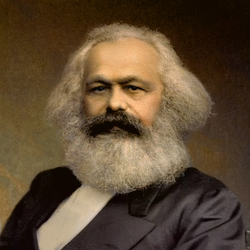
Ask someone what they think of Karl Marx and you'll get opinions. Hot ones. Strong ones. Opinions delivered with remarkable confidence for someone who, in all likelihood, couldn't tell you his first name.
It's Karl, by the way. Karl Heinrich Marx. Born 5 May 1818, in Trier, a small city in what is now western Germany, then part of the Kingdom of Prussia. He was the third of nine children, son of a lawyer, raised in a household that was comfortable, educated, and perpetually caught between worlds.
That last part matters. Because the tension Marx would spend his entire life trying to understand began, in a small way, right there in his own home.
The World He Was Born Into
His father Heinrich was a successful lawyer who revered Kant and Voltaire, and was a passionate activist for Prussian reform. Although both parents were Jewish with rabbinical ancestry, Karl's father converted to Christianity in 1816, most likely as a professional concession in response to laws restricting Jews from public life. He was baptised Lutheran rather than Catholic, the predominant faith in Trier, because, as the family reasoning went, Protestantism meant intellectual freedom. Biography
So even before Karl could read, his family had been asked to choose between identity and opportunity. They chose opportunity. The world, apparently, had opinions about who deserved to participate in it.
The world Karl Marx grew up in was the early industrial revolution at full, terrifying throttle. The England he would later call home was a place where children as young as four and five worked for their "employers" in conditions that would make a modern reader's stomach turn. Across Europe, millions of people were moving off farms and into factories, trading the precarity of agricultural life for the precarity of sixteen-hour shifts, dangerous machinery, and wages that kept you alive just barely enough to show up the next day. papertrell
This wasn't ancient history. This wasn't someone else's problem. This was the world Marx watched through his own eyes, in real time, and tried to make sense of.
The Man Himself
Marx was, by most accounts, a handful.
At university in Bonn, he participated in customary student activities, fought a duel, and spent a day in jail for being drunk and disorderly. He presided over a tavern club at odds with the more aristocratic student associations. His father, by all accounts a patient man, eventually insisted he transfer to the more serious University of Berlin. Marx went, studied law and philosophy, and promptly became obsessed with Hegel. Encyclopedia Britannica
He wanted to be an academic. His early radicalism, first as a member of the Young Hegelians, then as editor of a newspaper suppressed for its social and political content, preempted any career aspirations in academia and forced him to flee to Paris in 1843. Econlib
In Paris, he met Friedrich Engels. They would be inseparable until Marx's death.
In 1836, as he was becoming more politically zealous, Marx was secretly engaged to Jenny von Westphalen, a sought-after woman from a respected family in Trier who was four years his senior. They married in 1843 after a seven-year engagement. The two had seven children together, four of whom died before reaching adolescence. BiographyEncyclopedia Britannica
Let that land for a moment, a family that saw more than 50% of their children perish before having the chance to grow up.
After the defeats of the 1848 revolutions, and after burning their bridges to employment and support networks of "respectable" society, Karl and Jenny found themselves overwhelmed in the stark poverty of exile, living in unhealthy slums with bill collectors perpetually beating at the door. Financial free fall was a way of life. SocialistWorker.org
Engels took up work in his father's textile manufacturing company in Manchester to provide consistent financial support to the Marx family.
The man who co-wrote the Communist Manifesto spent years working in a factory, not because he believed in factory work, but because his friend's family was starving. International Socialist Review
Marx, meanwhile, was in the reading room of the British Museum, working through back issues of The Economist and building the theoretical framework that would become Das Kapital. He was irascible, obsessive, chronically ill, and apparently quite funny in his letters. His family called him "the Moor", a nickname from his dark complexion, used affectionately. His daughter described him as a devoted, playful father who told them sprawling stories that never ended.
He died on 14 March 1883. He was 64. His original grave had only a nondescript stone. The large tombstone with his bust wasn't erected until 1954, by the Communist Party of Great Britain. Biography
What He Actually Argued
Here's where we need to be precise. Because the gap between what Marx wrote and what was done in his name is roughly the size of the gap between Jesus of Nazareth and the Spanish Inquisition.
Marx wasn't a simple man with simple ideas. He was a philosopher, economist, historian and sociologist who spent decades building a system of thought. But here are the broad strokes, in the spirit of the Echoes books, let's break them down clearly.
Historical Materialism
The idea: History isn't driven by great men or divine will; it's driven by economic conditions. Who controls the means of production (the farms, the factories, the machines) controls society.
What it actually means: The rules, laws, culture and ideas of any era tend to reflect the interests of whoever holds economic power in that era. This wasn't a call to arms; it was an analytical framework.
What everyone says it means: Communism. Gulags. The end of private property. (Breathe. That comes later, and even then, it's more complicated.)
Alienation
The idea: Under industrial capitalism, workers become disconnected from their own labour; they make things they don't own, for people they'll never meet, in exchange for just enough to survive.
What it actually means: Work can either express something meaningful about a person, or it can be an extraction. Marx argued industrial capitalism structurally produces the latter.
What everyone says it means: Laziness. Entitlement. Not wanting to work. (This is almost the exact opposite of what he meant.)
Surplus Value
The idea: If a worker produces £10 worth of goods in a day and gets paid £5, the other £5 goes somewhere. Marx called that gap "surplus value" — the source of profit.
What it actually means: An economic analysis of where profit comes from. Contentious, debated, but not inherently wild.
What everyone says it means: That all business owners are evil. (He was making an economic argument, not a moral one, though moral implications weren't lost on him.)
Class Struggle
The idea: Throughout history, society has been defined by conflict between those who own the means of production and those who work them.
What it actually means: The interests of employers and employees are structurally in tension. Not always in open conflict, but always in tension.
What everyone says it means: Violent revolution, always, immediately. (Marx did predict revolution, but he also thought it would emerge from specific historical conditions, not because someone read a pamphlet.)
Communism
The idea: Eventually, Marx argued, capitalism's internal contradictions would lead to its collapse, giving way to socialism and ultimately a classless, stateless society.
What it actually means: Marx was notably vague on the specifics. He declined to draw up detailed blueprints. The destination was a society where people contributed according to ability and received according to need.
What everyone says it means: The Soviet Union. North Korea. Bread queues. Gulags.
Here's the thing: the Soviet Union was established in 1922. Marx died in 1883. He had no say in what Lenin built. None. He never met Stalin. He never endorsed a one-party state. He couldn't; he was dead. Wikipedia
Blaming Marx for the Soviet Union is a bit like blaming Charles Darwin for eugenics. Someone took the ideas, stripped out the nuance, bolted on their own agenda, and called it the same thing. It wasn't.
The Misquotation Problem
A quick note, because it deserves one: an enormous number of quotes attributed to Marx are things he never said.
"Religion is the opium of the people" — he did say something like this, though the full quote is considerably more nuanced and compassionate than it sounds in isolation.
Karl Marx, 1844
"Religious suffering is, at one and the same time, the expression of real suffering and a protest against real suffering.
Religion is the sigh of the oppressed creature, the heart of a heartless world, and the soul of soulless conditions.
It is the opium of the people."
Opium in 1844 was medicine. It was what you gave people in pain. He wasn't sneering. He was describing a world that hurt people badly enough that they needed it.
The actual closing lines of the Communist Manifesto, the ones that have echoed through every protest, every union hall, every raised fist for 175 years, are not quite what most people think they are.
The famous version: "Workers of the world, unite! You have nothing to lose but your chains!"
One sentence. Clean. Devastating. Except it isn't one sentence. It's four, compressed across different parts of the original text until the seams disappeared. The official English translation, approved by Engels himself, reads like this:
Karl Marx & Friedrich Engles, The Communist Manifesto, 1848
"Let the ruling classes tremble at a Communistic revolution.
The proletarians have nothing to lose but their chains.
They have a world to win.
Working Men of All Countries Unite!"
Read them separately. Let each one land.
Let the ruling classes tremble. That is not a slogan. That is a calm, fully argued promise delivered at the end of a document that had just spent thousands of words explaining precisely why they should be afraid. No wonder they spent the next century turning it into a bumper sticker and then making fun of the bumper sticker. The caricature is dismissible. Those four lines in full are not.
But those words didn't arrive from nowhere.
Five years before the Manifesto was published, a French feminist socialist named Flora Tristan wrote a book called The Workers' Union. It was 1843. She had been born into a family that fell into poverty when her father died, had worked from childhood, had married at seventeen, had fled a violent husband with her children, had been shot in the street by that husband and survived, and had spent the years since travelling Europe documenting the lives of working people with the rigour of someone who had lived those conditions herself.
In that book, she wrote the idea first. The call for workers to unite across borders, across trades, across the divisions that kept them negotiating alone against power that was organised and unified and intended to stay that way.
She died in 1844. One year after the book was published. Exhausted, largely destitute, forty-one years old.
Marx visited her grave. He knew.
Her idea. Their megaphone. History's selective memory doing what it has always, reliably, done.
The misquotation problem runs deeper than clipped sentences and compressed slogans. Sometimes the quote itself is real enough, and what gets lost is simply who spoke first.
Flora Tristan spoke first.
Most of the inflammatory one-liners — not him. The internet is a wild place.
So What Do We Do With All This?
Here's what seems clear: Karl Marx was a human being. A flawed, brilliant, difficult, funny, grieving human being who watched the world he lived in and tried to understand why it worked the way it did. He didn't found the Soviet Union. He didn't design the gulags. He wrote books.
You don't have to agree with him. Plenty of serious economists and historians don't. But disagreeing with a caricature isn't the same as disagreeing with the man. And calling something Marxist — or socialist, or communist — because you don't like it, without knowing what any of those words mean, is precisely the kind of linguistic sleight of hand we were talking about in The Brief.
The butterfly problem, again.
Just because you call something by a name doesn't make it that thing.

Systems & Signals
The Architecture of Equality
Six words.
Everyone has the right to vote.
Done. Democracy achieved. You can go home.
Except, can you read the ballot? Can you afford to take the day off work? Can you get to the polling station when you're too sick to leave the house, too exhausted from sixty-hour weeks to care, too ground down by a system that has taken everything you ever earned to believe that your voice changes anything at all?
Democracy is the promise. It is a beautiful, radical, necessary promise. But a promise written on paper doesn't build a road. And if you can't get to where the promise lives, it doesn't matter how beautifully it's written.
This is the problem that a word, a single, battered, weaponised word, was invented to solve.
That word is socialism.
Where It Came From
The concept of collective responsibility for the common good is ancient. Plato was poking at it in 360 BC. Thomas More sketched an outline in Utopia in 1516. But the word itself — socialism, in its modern sense — dates to at least 1822, emerging from the Owenite tradition in England. Wikipedia
Robert Owen was a Welsh mill owner, which is already an interesting starting point for the founder of English socialism. He had owned and operated textile mills in Lanark, Scotland, and proposed systems based on small collective communities rather than a centralised state. He'd seen from the inside what industrial capitalism did to human beings, and decided there had to be a better architecture. HISTORY
Early socialists like Henri de Saint-Simon, Robert Owen and Charles Fourier offered models for social organisation based on cooperation rather than competition. They weren't identical in their visions: Saint-Simon wanted experts running things at scale, Owen wanted small cooperative communities, Fourier had ideas so eccentric they deserve their own newsletter, but they shared a core conviction: that a society serious about human dignity had to build the structures that made dignity possible. Not just declare it. The Week
This was not a fringe position dreamed up by bearded revolutionaries in attic rooms. It was a direct response to the social and economic inequalities arising from the Industrial Revolution, which is to say, it was a response to observable reality. Children working fourteen-hour days. Families living eight to a room. Men dying in factories before they turned forty. And a political system that said, formally, that all men were equal, while quietly ensuring that only men who owned property could vote on what equality meant. Fiveable
The Fight They Were Actually Having
This is where the Chartists come in, and they deserve a moment.
The Chartist movement was the first mass movement driven by the working classes, growing out of the failure of the 1832 Reform Act to extend the vote beyond those owning property. In 1838 they drafted the People's Charter: six demands: universal manhood suffrage, annual parliaments, a secret ballot, equal electoral districts, abolition of the property qualification for MPs, and payment of MPs. UK ParliamentEncyclopedia.com
That last one sounds almost quaint now. Pay MPs. Why? Because if you don't pay them, only rich people can afford to be MPs. And if only rich people are MPs, you can probably guess whose interests Parliament tends to represent.
In June 1839, the Chartists presented their petition to the House of Commons with over 1.25 million signatures. Parliament rejected it summarily. UK Parliament
The point isn't that the Chartists were socialists in the modern sense; the movement was broad and messy and internally divided, as mass movements always are. The point is that the fight for the vote and the fight for the conditions under which the vote could mean something were always the same fight. You cannot meaningfully participate in democracy if you are illiterate, starving, working every hour of every day, or legally excluded from the process because you don't own enough land.
The vote without the floor is a performance. Socialism, at its most basic, before the Cold War got hold of the word and garrotted it, was the argument that someone has to build the floor.
What the Floor Looks Like
Here's what the floor looks like in Australia in 2025. See if any of this sounds familiar.
You wake up sick. You go to the doctor. You pay nothing, or close to nothing, because Medicare, introduced on 1 February 1984 under the Hawke government, is a universal health insurance scheme that provides all Australians with access to free or subsidised medical and hospital care regardless of their financial situation.
Medibank — the original blueprint for universal healthcare in Australia — was first introduced by Gough Whitlam's government in 1975, after a battle so fierce it triggered a double dissolution election. Fraser's Coalition dismantled it piece by piece. Hawke rebuilt it and called it Medicare."
Before Medicare, three out of five families didn't have private health insurance because they couldn't afford it. There was no bulk billing. People had to pay for a visit to the doctor in full at the time. Hospital and medical expenses were one of the largest reasons for personal and non-business-related bankruptcy. After Medicare, they removed it from the published list of reasons. Because it fell so low it wasn't worth tracking. Australian Government Department of Health
Your kids go to school. Free.
Compulsory free public education wasn't always assumed. Prussia built the first national system in 1763. England didn't follow until the Elementary Education Acts of 1870 and 1880 and didn't make it fully free until 1891. The argument that had to be won, in parliament and in public, was this: that educating everyone was a responsibility of the state, not a charity for the poor. It took the better part of a century to win it.
Your house catches fire. You call the fire brigade.
Before public fire brigades, insurance companies ran private ones. They protected insured buildings. Uninsured buildings burned. The first organised municipal fire brigade in the world was established in Edinburgh in 1824 funded by the city, for everyone. The idea that your house shouldn't burn down simply because you couldn't afford a policy was, at the time, a radical proposition.
You drive on roads built with public money.
Public roads funded by taxation aren't a modern invention, Roman roads were maintained through taxes, with officials called curatores viarum responsible for funding repairs. The principle that infrastructure serving everyone should be paid for by everyone is literally ancient. We've just spent several centuries arguing about it as though it's a new idea.
Drink water cleaned by public infrastructure, and live under the protection of laws enforced by a publicly funded justice system.
Clean drinking water delivered to your tap is the product of one of the most consequential public health decisions in history. Cholera outbreaks killed tens of thousands in London in 1832, 1849 and 1855 before the city finally built a public sewage and water system. The British Medical Journal's readers voted the sanitary revolution, clean water and sewage disposal, the greatest medical breakthrough in history. It happened because government decided clean water was a public responsibility, not a private luxury.
All of this is socialism. Not the Soviet kind. Not the gulag kind. Not the kind that lives in the nightmares of American cable news anchors. The quiet, functional, utterly normal kind that Australians use every single day without thinking about it, and frequently vote against when someone waves the word at them like a warning flag.
The Deliberate Forgetting
So how did we get here? How did a word that describes the fire brigade become the rhetorical equivalent of a slur?
The short answer is the Cold War. The United States spent the better part of fifty years, and enormous amounts of money, conflating socialism with Soviet communism, and Soviet communism with everything frightening about the twentieth century. It was effective. Devastatingly effective. So effective that the conflation survived the Cold War and is still doing its work today, in countries that have never had anything remotely resembling a Soviet system, in debates about whether sick people should have to pay to see a doctor.
The slightly longer answer is that it was useful to someone. A population that understands what socialism actually is and can see it functioning in their daily lives is a population that might start asking why some parts of the floor are missing. A population that hears the word and flinches is much easier to manage.
Words as weapons. We've been here before this edition.
The Thing Nobody Says Out Loud
Australia is one of the most successfully socialist countries on earth.
Not in every way. Not perfectly. There are enormous gaps in that floor, gaps that fall along very predictable lines of race, class, geography, and age. But the architecture is there. The principle is there. The idea that a society owes its members certain basic conditions of participation: health, education, safety, infrastructure, is so thoroughly embedded in Australian life that we've forgotten it was ever a political choice.
It was a political choice. People fought for it. Some of them went to prison for it. Some of them were deported to Australia for it, which has a certain irony.
And the word for it, the actual, honest, historically accurate word for the system that means you don't go bankrupt when your appendix bursts, is socialism.
You're welcome to keep not using it. The fire brigade will still come.
Culture & Media
Showing Up
I'll be honest with you. This piece scared me a little.
Not because there's anything particularly dangerous in writing about a television show. But because writing about this television show, from this vantage point, requires me to step briefly out from behind the curtain. And Atlas Media isn't about me. Except that it is, and has to be, because if it isn't personal, it has no meaning. To anyone.
So. Here we are.
I exist. Specifically, I exist as a member of the LGBTQIA+ community, in a world that has, depending on which decade you happened to be alive in, variously imprisoned people for that, electroshocked them, institutionalised them, shamed them out of their families, and occasionally, grudgingly, extended them something approaching equal rights before trying to take it back again.
We got gay marriage. Then had to fight to keep it. Laverne Cox stood proudly and wonderfully in the spotlight of a hit television show, and then Caitlin Jenner used her platform and privilege to betray the very community she claimed to represent. The pendulum swings. It always swings.
And through all of it, the wins and the losses and the exhausting, relentless negotiation of simply existing, the thing that has mattered, quietly and consistently and more than most people who've never had to live without it will ever fully understand, is representation.
Seeing yourself. In the story. Not as the punchline, not as the cautionary tale, not as the tragic figure who dies in the second act so the straight characters can have feelings about it. As the story.
The Show
Heated Rivalry is based on Rachel Reid's Game Changers book series. It stars Hudson Williams as Shane Hollander and Connor Storrie as Ilya Rozanov, two professional hockey players maintaining a secret long-term romantic relationship while playing for rival teams.
I haven't read the books. I'll be transparent about that. I don't know how faithful the adaptation is, whether things were lost or gained in translation from page to screen. What I know is what I watched. And what I watched was something that felt, in a media landscape drowning in reboots, sequels, prequels, spin-offs and the kind of toxic nostalgia that mistakes familiarity for quality, genuinely, unexpectedly fresh.
What Heated Rivalry is doing, and doing very well, is constructing a permission structure.
It's painting a world where it might be okay. Where the cost of being who you are is real and acknowledged and portrayed without flinching, but where the possibility of love, of being known, of not being alone in it, exists. Where that possibility is treated as worthy of a story. Not a footnote. Not a subplot. The story.
In a world where no such permission structure currently exists without severe career and financial consequences — particularly in professional sport — that matters more than it might appear to.
The Details That Land
The show doesn't shy away from the specific texture of navigating intimacy and desire in a world built entirely around the assumption of opposite-sex attraction. The extra steps. The calculations that straight people simply don't have to make.
Asking someone out requires, for most people, a certain vulnerability. Fair enough. Add to that the prior step of determining whether the person you're drawn to is even oriented in a direction that makes the question possible, and doing that without revealing yourself in the process, and you start to get a sense of the mathematics involved. The show portrays this not as exotic or melodramatic, but as ordinary. Which it is. For a lot of people.
Grindr pioneered geolocation dating technology when it launched in 2009, the first app of its kind, built specifically because gay men needed a way to find each other that the straight world simply didn't require. As Grindr's own communications team put it: "Gay people have always had a need to find each other in any situation... due to the nature of the gay community not always being accepted, we have always had to come up with ways to meet each other." The app pioneered geolocation dating technology that Tinder, Bumble and every other mainstream platform subsequently adopted and built empires on, while the community that invented the need, and then the solution, continued to be treated as the butt of the joke for using it. NBC NewsVerdict
Heated Rivalry understands this. It doesn't use the mechanics of closeted life as a plot device. It uses them as a mirror — holding up something that millions of people live with daily and saying: " We see this. We think it's worth a story.
The Craft
The casting is well chosen. Openly bisexual actor François Arnaud appears in a supporting role, and transgender actor and former professional hockey player Harrison Browne also features, the production's commitment to queer representation extending behind the camera as well as in front of it, helmed by out gay showrunner Jacob Tierney. WikipediaOut.com
The friends are portrayed without caricature. The parents played with nuance. The relationships written and performed with originality and genuine depth. The jokes are never at anyone's expense. The sport is background, not foreground, a pressure cooker the story is set inside, not the point of the story itself.
And the central relationship, enemies to lovers, rivals to something far more complicated, is, at its bones, Romeo and Juliet. Two people on opposite sides of a line, wanting what they're not supposed to want, paying the price the world extracts for wanting it.
Shakespeare, for the record, would almost certainly have had thoughts about queer representation. We'll never know for certain. But the man wrote Twelfth Night, so.
Why It Matters
During production, the lead actors received private correspondence from active players in the NHL, NFL, and NBA, sharing their experiences of concealing their sexual orientation. Real athletes. Currently playing. Writing to the cast of a television show because something in it touched something they couldn't say out loud. Wikipedia
That's what representation does. That's the whole argument, made concrete.
You don't know what you're missing until you see it. And once you see it, yourself, in the story, treated as worthy of one, something shifts. Sometimes quietly. Sometimes in ways that take years to surface. Sometimes, in a letter to an actor from a professional sportsperson who can't sign their name to it.
The pendulum swings. But sometimes, in amongst the noise, something shows up and does the quiet, necessary work of saying: you exist. And that's worth a story.
Heated Rivalry showed up.

From the Librarium
There's No Place Like Home
Lyman Frank Baum was, by any measure, a man who failed spectacularly and often.
He failed as a theatre producer. Failed as a store owner, his habit of extending credit to anyone who asked eventually bankrupted Baum's Bazaar in Aberdeen, South Dakota. Failed as a newspaper editor when the paper folded beneath him. Failed repeatedly in business with the cheerful, boundless enthusiasm of a man who simply could not imagine that the next thing wouldn't work out.
He was born in Chittenango, New York in 1856, married Maud Gage in 1882, daughter of Matilda Joslyn Gage, one of the most prominent feminist and suffrage activists of the nineteenth century, and spent the following decades ricocheting between careers with more imagination than success.
He was also, it turns out, a visionary. His books imagined television, augmented reality, wireless telephones and laptop computers, decades before any of them existed. He was secretary of Aberdeen's Equal Suffrage Club. He hosted Susan B. Anthony in his home. He absorbed the politics and landscape of drought-ridden South Dakota, the grey flatness, the economic despair, the broken promise of the frontier, and transmuted them into the grey Kansas that Dorothy so desperately needs to escape.
He was also, in 1890, the author of two newspaper editorials calling for the extermination of Native Americans in the aftermath of Wounded Knee. His descendants travelled to South Dakota more than a century later to apologise to Sioux descendants for the words he wrote. We note it because we always note it. The work is extraordinary. The man was complicated. Both things are true simultaneously, and pretending otherwise would do justice to neither.
From that complicated, restless, frequently bankrupt, genuinely visionary human being — at the age of forty-four, after a lifetime of almost everything else — came The Wonderful Wizard of Oz.
The Book They Made the Film About
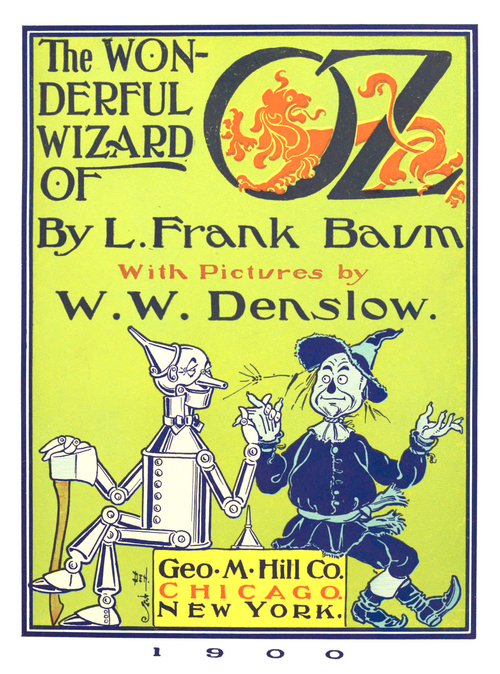
Published in 1900, illustrated by W.W. Denslow, dedicated simply "to my good friend & comrade, My Wife."
You know the story. Or you think you do. A girl from Kansas, a tornado, a land of impossible colour, a yellow brick road, companions gathered along the way, a wizard behind a curtain, a journey home.
What you may not know or may have forgotten is how differently the book breathes from the film. The film is a dream sequence; literally, Dorothy wakes at the end, safely back in Kansas, the whole adventure perhaps imagined. The book offers no such comfortable explanation. Oz is real. Dorothy's companions are real. The magic is real. She goes home because she chooses to, not because she wakes up.
The silver slippers, not ruby, MGM changed them for Technicolour. A small detail that contains a larger truth: the film is magnificent, groundbreaking, an achievement that deserves every piece of its legend. And it is also a different story, filtered through a different lens, shaped by different hands for different purposes. Judy Garland's Dorothy is one of cinema's great performances. Baum's Dorothy is something slightly different, more matter-of-fact, less trembling, more quietly competent.
Some scholars have long read the book as political allegory, the Emerald City where everything appears green because everyone is required to wear green glasses, the Wizard revealed as a fraud projecting false power, the Wicked Witch defeated by something as ordinary as water. Baum himself always maintained he wrote it simply to please children. Both things can be true. The best allegories don't announce themselves.
The World He Built
What followed the first book was fourteen more, a whole world, populated over two decades with increasing strangeness and delight. The Nome King and his tunnelling army. Billina the chicken, who saves the day through sheer practical competence. Princess Ozma, who believes in gender equality and proves it. General Jinjur, leading the women of Oz in revolt, armed with knitting needles, successfully overthrowing the men and making them do the housework. Tik-Tok, the mechanical man, a robot, in 1907.
Baum's works anticipated things so far ahead of his time that reading the list feels slightly eerie: television, augmented reality, wireless telephones, laptop computers, the ubiquity of advertising on clothing. He wasn't writing fantasy as escapism. He was writing fantasy as a way of seeing the world more clearly, which is what the best fantasy has always done.
The series found its LGBTQIA+ community long after Baum's death, and held them. There is something in Oz, the found family, the journey toward a place where you belong, the discovery that the power was inside you all along that speaks to people who have had to build their own maps home. That connection was never incidental. It was always in the bones of the thing.
What's in the Librarium
We're beginning, as Baum did, at the beginning.
The Wonderful Wizard of Oz is now available in the Atlas Librarium — free, in your browser, no account required. Because a story this good belongs to everyone.
This is the first. There are thirteen more. And the world Baum built across all of them, strange, generous, politically layered, occasionally ridiculous, frequently wonderful, deserves to be read properly, not just remembered through a single film, however beloved.
We'll be adding to the Oz shelf. Watch this space.
There's no place like home. There never was.

Projects & Progress

The Mouseion — A Place for Everything Worth Knowing
It is noted throughout the history books from across the ancient world that every ship that docked in the harbour of Alexandria was required to surrender its books. Not permanently, the scrolls were taken to the library, copied by the scribes who worked there, and returned to their owners when they left. Alexandria kept the originals. This was not a request. It was policy, enforced by the most powerful city in the ancient world, driven by a single obsession, that every piece of written knowledge that existed should pass through Alexandria, be recorded, and be preserved.
Alexander the Great began the building of one of the ancient world's greatest cities in 331 BCE. He never saw it in its glory. After his death 8 years later, his general Ptolemy took control of Egypt and made Alexandria its capital, and there it grew to become the largest city in the world, outside of Rome. The most cosmopolitan city on Earth — Melbourne, 2000 years before its time — Greeks, Egyptians, Jews, Romans, Persians, Phoenicians, Nubians and more.
The Library of Alexandria was the heart of it. A part of it. The part most people remember, those who remember at all. But the idea was older and larger than any building.
The Mouseion. The Seat of the Muses. Not a library, an institution. A place where scholars were paid by the state to do nothing but think, argue, calculate, observe and write. The library served it. The library was its memory. But the Mouseion was its mind.
And the Mouseion was not born in Alexandria. It was already old when Ptolemy built his version of it. Plato had walked the groves of his Academy in Athens three generations earlier, teaching through conversation, through argument, through the radical idea that truth was something you pursued together rather than inherited from above. Aristotle had founded his Lyceum, where students walked as they debated, the Peripatetics, 'the walkers', because even the body should be in motion when the mind is working.
Alexandria gathered all of that and scaled it. Made it a city. Made it a policy. Made it the centre of the world.
What it produced within those walls is almost impossible to absorb in one sitting.
Euclid wrote his Elements there, the geometry textbook still used two thousand years later.
Eratosthenes, serving as chief librarian, calculated the circumference of the earth using two sticks and the angle of sunlight, and was accurate to within one per cent.
Aristophanes of Byzantium invented punctuation there — the marks you are reading right now, the pauses and stops that give written language its breath.
Aristarchus of Samothrace proposed that the earth orbited the sun, eighteen centuries before Copernicus would be celebrated for the same idea.
They argued constantly. Callimachus and Apollonius of Rhodes conducted one of history's great literary feuds within those walls, a bitter, public, and extraordinarily productive one. Callimachus, who never held the title of chief librarian but shaped the library more than anyone, created the Pinakes, the world's first library catalogue. One hundred and twenty volumes, organising every scroll by subject, author, and opening line. The world's first bibliography, written to make sure nothing could ever be lost or forgotten.
And then it burned.
Not once. The fires came in waves across the centuries, Caesar's forces in the harbour, the edicts of emperors, the slow erosion of neglect and underfunding that finished what the flames began. What survived did not survive in Europe. Europe was busy. The Roman Empire had collapsed, the roads had crumbled, the monasteries were copying what little they had, but the great tradition of open inquiry, of state-funded scholarship, of knowledge as a civic institution, that flame had gone out in the West.
It was kept alive in the East.
In 830 AD, the Abbasid Caliph Al-Ma'mun founded Bayt al-Hikmah in Baghdad — the House of Wisdom.
It was not an imitation of Alexandria. It was a continuation of it.
Scholars from across the Islamic world and beyond, Arabs, Persians, Christians, Jews, Zoroastrians, gathered to translate, to preserve, and to extend. The works of Aristotle, Euclid, Hippocrates, and Ptolemy, texts that Europe had lost or never had, were translated into Arabic, studied, debated, and built upon. Al-Khwarizmi invented algebra there. Ibn al-Haytham founded the science of optics there. Al-Biruni calculated the radius of the earth with extraordinary precision there. Avicenna wrote the Canon of Medicine there, a text that would remain the standard medical reference in both the Islamic world and Europe for six hundred years.
When Europe finally woke from its long sleep and began its own Renaissance, it was largely reading Arab translations of Greek texts. The thread of the Mouseion had been carried, carefully, through the darkest centuries, by scholars whose names the West has largely chosen to forget.
The House of Wisdom burned in 1258 when the Mongols sacked Baghdad. Contemporary accounts say the Tigris ran black with ink for days. The greatest repository of human knowledge since Alexandria, destroyed in a week.
The tradition survived. It always survives. But it has never again had a true home.
What the Mouseion Is
The Mouseion is named for the original, the Alexandrian institution that housed the great library, the scholars, the debates, the lectures, the experiments. It was not just a library. It was a place where people came to think, to argue, to teach, to learn, and occasionally to completely change how humanity understood the world.
Ours is built on three foundations, each drawn from the ancient world:
From Alexandria — the Librarium.
A curated collection of books, carefully cleaned and formatted, freely available. Not a dump of every public domain text ever digitised. A library, selective, tended, growing deliberately. Every volume chosen for a reason. Every edition prepared with care.
From Athens — the Academe.
Plato taught in a grove outside the city called the Academy. His students didn't sit in rows and take notes. They walked, argued, questioned, and built ideas together. The Academe within the Mouseion is our version of that grove, structured learning pathways, degree-equivalent curricula built from publicly available knowledge, a place to think seriously about serious things.
From Rome — the Scriptorum.
Rome understood that knowledge needed to be recorded, preserved, and transmitted. The Scriptorum is our research archive, curated papers, primary sources, legal documents, essays and journalism worth keeping. The back-of-house scholarship that supports everything built on top of it.
And — the Theatrum
Somewhere in the middle of all of it. Because not everything worth knowing arrives in text.
What We Are Building
We will be honest with you. This is not finished. It probably never will be, at least that is the goal. The Atrium is open, the Librarium has its first volumes, and the foundations of everything else are laid.
But the Mouseion, like its Alexandrian predecessor, will not be built in a day.
What we can tell you is what it will become. A library wing that grows every week. A research archive that curates rather than accumulates. A learning environment that treats you as an adult capable of genuine intellectual engagement. A place to debate, to explore, to disagree productively, and to leave knowing something you didn't when you arrived.
We are also looking for scribes. If you have knowledge worth sharing: research, writing, expertise, volumes looking for a home, the Mouseion is being built for exactly that. We respect intellectual property absolutely. If you want to contribute freely, your work will be tended carefully. If you want to sell your work through these halls, we are working on making that possible, too, and we will make sure every coin finds its way back to you. And if you just want to help record history, while it's happening... we have room for you to.
As It Once Was, So It Will Be Again
The great institutions of the ancient world were not built by governments or corporations. They were built by people who believed that knowledge mattered enough to dedicate their lives to gathering, preserving and sharing it.
They were maintained by communities of scholars, patrons, students and scribes who understood that the work was bigger than any one of them.
We are one person with a laptop and an extremely stubborn belief that this is worth doing.
But we are looking for more. Collaborators, contributors, readers, scholars, scribes. People who believe, as we do, that the library should never have burned.
Come in. Look around. The Atrium is open.
— The Archivist
The Atlas Brief publishes monthly. Subscribe free at atlasmedia.press to receive future editions directly.


